Friday, March 11, 2016

Draft Update: Still Incredibly Early Edition


Will Benson
    The Blue Jays have the 23rd overall selection in the first round of this June's amatuer draft.
They also have the 57th pick (as a result of not coming to terms with Florida HS P Brady Singer), as well as their own at 66.

    Baseball America released their updated Top 100 draft prospects rankings yesterday, and while this list is notable only in its fluidity, it's interesting to see how the list changes and evolves from month to month.
     The Top 10 rankings really aren't of a lot of interest to Blue Jays fans, as those players will likely be off the board once it comes time for Toronto to pick, but it is interesting to watch how names rise and fall over the course of the spring.  The College baseball season is a couple of weeks old, and high school baseball has just started in the warmer states.  The scouting season has just begun.
     BA's top prospect so far is New Jersey HS LHP Jason Groome, who has been at or near the top of most lists.  Tennessee 3B Nick Senzel has rocketed up the rankings to the second spot on BA's list, mainly thanks to a breakout summer season in the Cape Cod League, and a sizzling start to the collegiate campaign.

    Under former GM Alex Anthopoulos, the Blue Jays coveted projection, particularly in the form of high school pitchers.  Even though much of their amateur scouting staff remains intact, it remains to be seen if there will be variance from that draft strategy with the new regime.  The Indians record when it came to first round picks under Shapiro has been dismal with the exception of Francisco Lindor, so it will be interesting to see if the new administration will allow the scouting department to operate as they have in the past.  One thing may change - Shapiro and GM Ross Atkins have shown an aversion to risk, so there may not be as much rolling of the dice on draft day.  You can't hold them to one draft, but the Indians and 21 other teams passed on Marcus Stroman in 2012.  It could be argued that they were willing to roll the dice with rehabbing Brady Aiken last year.  So, perhaps there's a good chance that the amateur scouting staff will go about their business as usual this spring.

   Last post, I looked at 3 players who were initially ranked in the 20s.  I'll update their progress, then profile a few other players who are ranked in that range.

RHP Cal Quantrill, Stanford
   The son of the former Blue Jay has yet to pitch this season, thanks to Tommy John surgery last spring, and won't take the mound in game action until late April or early May.  If he returns without missing a beat, he's likely to go in the top dozen or so picks; if he struggles, he may still be available. The bloodlines, advanced feel for pitching, and the projection make him an ideal pick if he's still on the board.

RHP Kyle Funkhouser, Louisville
   Selected 35th overall by the Dodgers last year, Funkhouser opted to return for his senior year.  So far, he's done little to reverse the slide that saw him fall out of the top half of the first round.  According to BA, his fastball was down to 88-91, his command was below average, and his offspeed pitches lacked consistency.
   He may well be available at 23, but unless there's a remarkable turnaround, it's hard to see Toronto selecting him.

RHP Forrest Whitley, Texas HS
   The 6'7" Whitley has hit 97 with his fastball, and oozes projection.  He also broke his left thumb last fall.  Keith Law of ESPN suggests the Tigers would pick him 9th overall.  He still remains in the 20s, but that velo may bump him up the list once March turns into April.

And now for a couple of players who are currently ranked in the 20s....

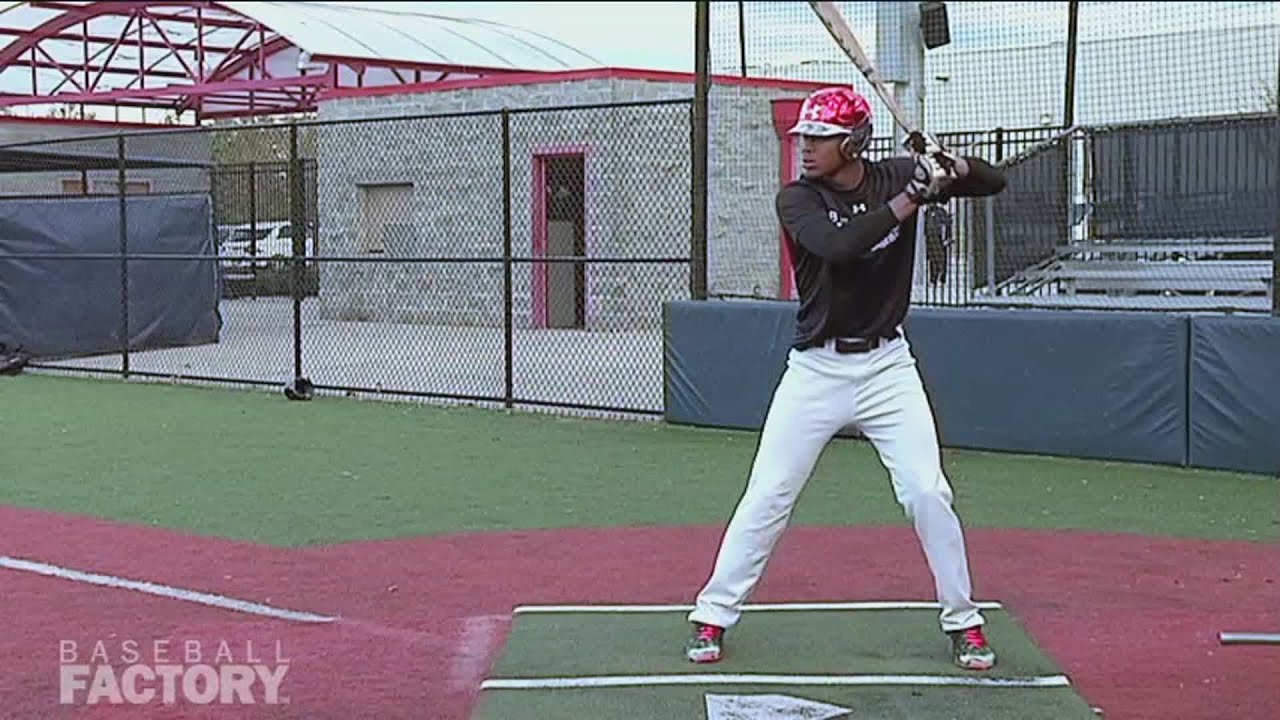
OF/1B Will Benson, Georgia HS
   The 6'5" Duke commit draws comparisons to fellow Georgian Jason Heyward.  Here are a couple of scouting notes:

Moves well in the outfield, strong arm.  
Agile around the bag at first.
Hands low at the plate, feet slightly wider than shoulder length. 
Slight leg kick.
Gets bat through the zone with excellent bat speed.
Pull side approach, ambushes balls on the inner half, not as fluid on the outer half and on offspeed where he feels for the ball a bit.
Approach will need to be refined on outer half. 

   Here's a glimpse of some of that bat speed:


RHP Reggie Lawson, California HS
   Lawson was deemed a scout's favourite last summer, with a fastball that touched 95, and nice, easy, and loose arm action.
   Law had a look at Lawson in action last weekend, and noted that while the velo is still there, his delivery seems to have taken a step backward.  His fastball was barreled up a few times because he offered little deception, and had trouble keeping the pitch down.  His curve flashed as a potentially plus pitch.
   Lawson is athletic and projectable, but Law was concerned that his delivery had regressed from just under a year ago.  Law thinks the mechanics could be easily fixed once he's in pro ball.
   Lawson seems to be a project at this point, which could keep him in the 20s.


   There is every chance that the Blue Jays will not take any of these players, of course, but it still helps to provide some interest.  Stanford and Louisville games can both be found online, making following the college players a little easier.  The players I've identified so far seem to me to be the type the Blue Jays like to follow, and I'll keep tabs on them in the coming weeks.


Tuesday, March 8, 2016

Blue Jays "Catcher of the Future": Blessing or Curse?

Max Pentecost MLB Prospect Portal Photo
     In their second year of existence in 1978, the Blue Jays selected Texas high school Catcher Brian Milner in the 7th round of the June draft.  A week after the draft, like many top picks, Milner was brought to Toronto to work out and see the city.  The fledgling Jays were so thin at the position that they decided to put Milner behind the plate for a couple of games (which may have been part of his signing deal in those pre-service time concern days).  He went 4-9 in the two games, hitting a triple and driving a pair of runs before heading west to Medicine Hat for rookie ball.  The future seemed very bright for the first Catcher in MLB history to be brought directly to the big leagues after the draft.
    Brian Milner was the first Blue Jay to acquire the "Catcher of the Future" label.
    Four years later, Milner's career was over, sidelined by injury and inconsistency.  Milner did not advance beyond AA. He remains the youngest player in club history, and the first "Catcher of the Future," who did not pan out.
   He would not be the last.

     Josh Phelps.  Curtis Thigpen.   Ryan Bundy.  J.P. Arencibia.  A.J. Jimenez.  Danny Jansen.  Max Pentecost......  

     The list of Catchers the Blue Jays have drafted since 1994 is quite staggering.  86 in all have been taken, but their sum total of major league experience in a Toronto uniform is just over 400 games, most of them by Arencibia.
    Is that "Catcher of the Future" label a blessing or a curse?  Why has it been so hard for Toronto to develop a home-grown player at this position?  Some of the answers lie in the very nature of the position, and the perils of drafting high school catchers.

Defence First
   Modern-day analytics have taught us more and more about the value of a premium catcher.  In the past, we may have thought mostly about a Catcher's ability to control the opposition running game as his chief defensive responsibility.  Now, we've learned that the Pitcher is at least equally as responsible for that, and that a Catcher's true value lies in his ability to frame pitches, block pitches in the dirt, and handle a pitching staff.  It has evolved into primarily a defence-first position;  you have to look no further than the 5 year/$85 million contract the Blue Jays gave Russell Martin prior to 2015.  Martin is no slouch with the bat, but make no mistake:  the work he did in leading the Pirates to their first post-season appearance in 20 years had everything to do with his skills behind the plate.
   So when a minor league player does show promise with the bat, the tendency has been to move him from the position, likely so as to not harm his production.  Bryce Harper caught all throughout high school and junior college before being drafted as an OF.  Wil Myers was behind the plate for a couple of minor league seasons, before being moved to the OF in order to get his bat to the major leagues faster.  Joey Votto and Jayson Werth were drafted as Catchers, but were moved off the position.  The Blue Jays own Josh Donaldson was drafted as a Catcher by the Cubs.  2014 1st rounders Kyle Schwarber and Alex Jackson didn't last much beyond a full season behind the plate.
   Of course, the opposite can happen as well.  Martin was drafted as a 3rd Baseman by the Dodgers, who converted him to Catching a year after his pro debut.
   The Blue Jays, for their part, have moved few players off the position once they've drafted them. Pentecost won't be Catching at the start of this season, but that owes more to his injury history than anything else.  The plan, for now, is to move him back once his surgically repaired shoulder allows him to.
 

Demands of the Position
   Sitting in an unnatural position for a couple of hours a day.  Dealing with foul tips.  Getting crossed up with the pitcher, who throws a fastball when you called for an off-speed pitch, leaving you exposed.  Trying to throw runners out without necessarily having time to plant properly, putting added stress on the shoulder.
   These are just some of the hazards Catchers face.
   Then there's what happened to Jansen.


  Pentecost's injury history is already well known, although he seems to finally be on the road to recovery. Jimenez had his career derailed by Tommy John surgery and other injury issues. And Jansen has had a difficult time staying healthy in his brief career - a knee injury sidelined him for half a (short) season in 2014. The development of all three have been affected, to varying degrees, by the demanding nature of the position.  Missed development time can be hard to make up.  

 Developing a Catcher Takes Time
 There are so many facets of the position to learn.  It's not unusual to see young arms or bats accelerate through a minor league system, but you rarely see a Catcher do so - especially one drafted out of high school.  Of all the positions on a baseball diamond, it's the position in most need of reps.  Estimates vary, but on average it takes several hundred minor league games for a Catcher to fully polish all of his receiving skills, as well as learn how to work with pitchers,  coaxing outs from them on days when they might not have their best stuff.
  At the moment, Jansen may be the most promising of the above trio.  Jimenez has yet to prove that he can hit at anything beyond a marginal major league level, and Pentecost's defence, which hardly drew rave reviews in college, has no doubt suffered as a result of his lost playing time.  But given the Jays one step at a time development approach, the earliest we might see Jansen (if he stays healthy) is 2018, or even 2019 - if at all.
  Developing a Catcher takes time, but because it's a long process, it increases the chance of injury.  Which sets back development.

Drafting a High School Catcher is Risky
   High School Catchers drafted since 2005 have produced a total of about 23 Wins Above Replacement, over half of that by Derek Norris and Yonder Alonso.  That's just not a great track record.
  Here are the leaders over the past decade-plus amongst high school Catchers:

NumNameYear DraftedCareer fWARRound Drafted
1Brian McCann200229.92
2Jarrod Saltalamacchia20038.01
3A.J Pierzynski199424.63
4Derek Norris20073.84
5Travis d'Arnaud2007-0.21
6Devin Mesoraco20071.91
SBNation Chart

  The high water mark for high school catchers was Joe Mauer, drafted by the Twins in 2001.  Mauer was the exception to the rule - a strong defensive backstop who at one time could win batting titles.  Time took its toll on Mauer, however, and he hasn't been behind the plate since 2013.  He's also a shell of his former self at the plate.  
  24 High School Catchers have been taken in the 1st round since Mauer in 2001, and Mesoraco leads them in WAR.  With all due respect, he's a decent MLB player, but it's hard to justify him as a 1st round pick.  D'Arnaud will in all likelihood pass him before long, but his six-year minor league apprenticeship (which had its share of injuries) reinforces the notion that developing a Catcher, especially one drafted out of High School, can take a long time.
   Take the case of Reese McGuire, drafted by the Pirates.  Drafted in the 1st round (14th overall) by Pittsburgh in 2013, he was labeled "A Natural" behind the plate, and was a Top 100 prospect in the eyes of Baseball America in 2013 (#81), and 2014 (#97).  He's nowhere to be found on that list this year, and wasn't even ranked a Top 20 Catcher by BA.  McGuire is still lauded for his defensive skills, but the concerns about his bat have grown every year.  He's still expected to be in the majors by 2017, but it's interesting how relatively quickly the shine came off of his top prospect label.
   A marked sign of the lack of depth of Catching prospects is that Penetcost, who has all of 109 Plate Appearances since being drafted in 2014 (and hasn't played a game in almost 20 months) has been named in the bottom half of a number of Top 20 Catching prospect lists.
   BA did a study about how many drafted players wind up in the Major Leagues. and found that about 17% of all players drafted between 1987 and 2008 for at least one game:

1987-2008 Drafts (22)
RoundTotalSignedMLBMLB%3YRS3YRS%Unsigned%
163361144673.023939.13.5
1st supp27326613952.34215.82.6
266662630949.410116.16.0
3-51,9061,74960534.617710.18.2
6-103,1652,77759821.51826.612.3
11-206,3294,90163813.01753.622.6
21+20,4338,1915536.81351.659.9
Total33,40519,1213,28817.2%1,0515.5%42.8%

   For Catchers drafted out of high school, that total would likely be even lower.  


  So, is that label one that blesses Blue Jays Catching prospects, or dooms them to an uncertain future?
   The label does ignore several facts, such as:
-the sheer volume of Catchers needed to fill out minor league rosters means that many will be called, few will be chosen.  
-developing a Catcher takes a long time - injuries, position switches, and other factors can interrupt or delay a prospect's development.  The gestation period for a Major League Catcher is likely longer than any other position.

 Should we view Jimenez, who is at this point likely a backup player at best, like another "Catcher of the Future," Robinzon Diaz (who was re-signed by the Jays this week?) as a failed COF?  
   No, because maybe it wasn't fair to put that label on him in the first place, just as it was with many other young Catchers.  Granted, he did put up some decent numbers in the lower minors, but when the competition became tougher at AA/AAA, he did not experience the same success at the plate. and the injuries caused by the wear and tear of catching didn't help, either.  Perhaps the media is in such a rush to anoint future saviours that they put labels on players before it's really fair or accurate to do so.  
  We should also consider that during the J.P. Ricciardi era, the emphasis for high draft picks was signability, not necessarily projection,  The Anthopoulos regime showed a fondness for athletic high school pitchers.  Drafting and waiting for a high school catcher was not necessarily a top priority.

  The Blue Jays, for the most part, have been an effective developer of players, but the Catching position is a different story.  The best player they have developed and drafted at the position was arguably Pat Borders  Maybe Pentecost of Jansen will change that, but they both have had - and will still have - obstacles to overcome.  In addition to trying to stay healthy, it will not be a surprise if Pentecost's offence forces him off of the position.  Jansen shows promise - he's already shown good pitch-framing and blocking skills, and the organization thought enough of him to have him handle the rehab start of Marcus Stroman last August, but on top of his own health concerns is that he hasn't proven that he can hit enough to advance to the majors.  

 And so the search for the Catcher of the Future continues.


Monday, March 7, 2016

Conner Greene Offers a Glimpse of the Future

Rocket Sports photo
  
Righthander Conner Greene made his spring training MLB debut on Saturday, striking out 3 of the 4 batters he faced in a one-inning relief stint against the Phillies.

  If there has been a constant in terms of player development and drafting during the reign for former GM Alex Anthopoulos, it has been that of the tall, lean, and athletic high school pitcher.  Greene, Aaron Sanchez, Noah Syndergaard, Daniel Norris, and Jon Harris are just a few of that type of pitcher acquired during the Anthopoulos era.  Certainly, they were able to step outside of that box to sign a Roberto Osuna and draft a Marcus Stroman, because the organization values projection above all else.
  When push has come to shove, however, the tall pitcher (who can change a batter's view of a pitch, possibly forcing him to lose the ability to track it thanks to its downward plane), who is lean (to better withstand the rigours of pitching 175-200 innings), and athletic (in order to consistently repeat his delivery and field his position) is what the Blue Jays coveted.
   Greene fits that profile to a T.  The Californian was drafted in the 7th round of 2013, and didn't make his full-season debut until last year - and what a debut it was, as Greene pitched well at 3 levels.  Hitting his innings limit meant that he wasn't sent to the Arizona Fall League for some extra reps against elite competition.
 
   In his inning of work, Greene did not face any legit MLB bats, but he worked well down in the zone, hitting 98 with his fastball at one point.  He went up against Nick Williams, the Phillies' 4th-ranked prospect, as well as journeymen Emmanuel Burriss and J.P. Arencibia, and non-prospect Ryan Jackson.  Greene walked Arencibia, and showed that his changeup may still need some refining, as the former Jay tomahawked one into the left field stands.   That was the only loud contact Greene gave up though, which is more in keeping with his projection as a ground ball machine. Striking out the side was a bit out of character - even though Greene struggles with his command from time to time, he's often only a pitch away from getting an inning-ending double play ball.

  I know that I can be rough on Blue Jays TV analyst Buck Martinez, who often appears to be spouting off whatever research his producers gave him, but he offered some good insights into Greene during the broadcast.  Martinez mentioned how Greene played all nine positions on his high school team, and described his athleticism as he watched Greene kick a soccer ball around before the game with Jose Bautista.  As a former Catcher, Buck can probably identify a good pitching prospect as well as anyone, and it was obvious that he sees one in Greene.


  How about some GIFs of Greene's performance?
His strikeout of Williams:


 A.J. Jimenez frames a strike beautifully against Arencibia:


The change that Arencibia was early on:


   Greene finished his season at New Hampshire, and with the veteran starting rotation that has been assembled at Buffalo, it's likely he returns to New England to begin this season. His development last year was no doubt accelerated by the trading spree Anthopoulos went on last July, but he still may have finished up at AA given his success in High A.
    That mid-rotation starter ceiling is looking more and more likely, although Greene still has a few things to work on, namely command of his secondaries like that change.  Against more discerning MLB hitters, that change he left out over the plate against Arencibia might have been hit to Kissimmee.

Monday, February 29, 2016

Anthony Alford: The Best is Yet to Come


@BaseballBetsy Photo
     18 months ago, the brain trust of the Blue Jays, led by then-GM Alex Anthopoulos, made the five-hour trek from Toronto to Lansing.
    The purpose of their trip was more than just to scout Toronto prospects toiling for the local entry in the Midwest League, the Low-A Lugnuts.  Anthopoulos and his cadre of senior execs had a contract extension offer in hand for Anthony Alford, who had just been promoted to Lansing a week earlier.

    Alford was one of the top high school baseball and football recruits in the nation.  Baseball America offered this scouting report in the spring of 2012:

Alford, a two-sport athlete, has committed to Southern Mississippi for both baseball and football. He's teammates in baseball with Garren Berry, son of USM baseball coach Scott Berry. And the Golden Eagles have a new football coach, Ellis Johnson, who has hired Alford's prep football coach onto his staff. In April Alford indicated he plans to go to college and play both sports. That's too bad, because many scouts considered Alford one of the class' elite athletes. Big and fast at 6 feet, 200 pounds, he was the Magnolia State's football player of the year as a quarterback and chose Southern Miss over such football powers as Louisiana State and Nebraska. He threw for more than 2,000 yards and ran for more than 1,700 as a senior, accounting for 44 touchdowns, but he's at least as intriguing on the diamond, where he's a 70 runner on the 20-80 scouting scale with power potential, too. He helped Petal High win back-to-back state 6-A championships before the team lost in the third round this spring, as Alford batted .483 with four homers.
   Scared off by the college commitment, Alford, who was considered a first-round pick in terms of talent, tumbled out of the top two rounds.  The Blue Jays, who had six picks in the first 100 thanks to letting free agents like Jose Molina, Jon Rauch, and Frank Francisco walk, decided to take a flyer with their seventh in Alford, joining 1st round pick and fellow Mississippian DJ Davis.

   Toronto was willing to wait on Alford, whose first pro summer was limited to 20 GCL plate appearances before heading off to begin his college football career.  His first season at Southern Miss was a bust, off and on the field.  He was one of four quarterbacks who stumbled their way to an 0-12 season, which cost Head Coach Elliott Johnson his job.  In October, Alford's mother was arrested after getting into an altercation with fans who were loudly berating her son's play during a one-sided loss.  This was not the first time mom had encountered trouble while watching her son play.  Alford's parents both had their issues with illegal drugs, and Anthony Alford Sr was arrested for selling Oxycodone in late 2013.
   After the dismal football season was over, Alford was involved in an on-campus incident, and was charged with assault, which was later reduced to conspiracy to possess a firearm, and hindering prosecution.  The incident, however, spelled the end of Alford's career with Southern Miss, and he left campus.  In the New Year, he signed on with Ole Miss, and attended spring practice, delaying his 2013 baseball season until June, and limiting his second pro campaign to 28 PAs.

    Throughout this, the Blue Jays were patient with Alford.  There certainly are two sides to every story, and the club was willing to believe that there were mitigating circumstances in the Southern Miss incident, and they were still committed to being patient with him.
     By 2014, however, that patience was beginning to wear thin.
    Alford had to sit out the 2013 college football season, according to NCAA transfer rules, and there was talk throughout baseball that his development was being limited by football, and the gap between Alford and his peers was growing.  Likely mindful of this, the Blue Jays assigned him to short-season Bluefield for a taste of "under the lights" play, and while the fans in Vancouver were full of anticipation of having Alford spend time at the next level with the Canadians, the Blue Jays skipped him to Lansing after only 9 Appy League games.
   His time in Michigan was brief, but Alford's speed and power combo had jaws dropping, posting a .320/.480/.480 line with 4 steals in only 5 games.  At the end of what proved to be his only week in Lansing, Alford and Anthopoulos sat down to discuss his extension.  Alford admitted that AA made it extremely hard to say no to a deal that likely involved more money than his $750K signing bonus, as well as an invitation to spring training the following year, but Alford did just that.  To top things off, he left Lansing shortly after to get married back home.
   The Blue Jays were likely less than impressed, but were not ready to cut ties with Alford just yet.


   It's hard for Canadians to understand the grasp football has on young men in places like Alabama, Texas, or Mississippi.  When you're the state player of the year, accolades from other sports are nice, but they're just distractions.  The expectation is that you will suit up for the Crimson Tide, or Longhorns, or Rebels, and do your hometown and state proud before setting off for a career in the NFL.  If you grow up without a lot, the path of riches probably seems to be paved with five yard markers and goalposts.  Such was the pressure on Alford to play football.  But somewhere along the line, he began to realize that his football dream was fading.  Maybe it was getting married, and recognizing that he will have to be a provider one day.  Perhaps it was reading the writing on the wall after being removed from Ole Miss' starting lineup after a failed season at QB with Southern. It may have been the forehead-smacking moment of revelation when Alford realized that he wanted to play baseball all along, and the Blue Jays were waving a good pile of cash in front of him to do so. Whatever it was, Alford shocked many when he gave up on football a month into the season (after saying that, "Even if I made $100 million from baseball, I'd still regret not giving football a shot,") and agreed to the Blue Jays offer.
   For the Blue Jays, the challenge was now how to make up for that lost development time.  He was able to squeeze in the last two weeks of Instructional League play, but Toronto was ready to accelerate Alford's timetable now that he had committed full time to baseball.  Even though they knew he likely would struggle, they shipped Alford and his new bride off to Australia, to play for Canberra of the ABL.  Along for the ride was Blue Jays minor league instructor Kenny Graham, who was Alford's GCL Manager, and is widely regarded as one of the best teachers in the organization. Graham served as Canberra's 3rd Base coach, but his main job was to tutor Alford in the fine points of baseball instruction he had missed.
   What ensued was a crash course in pitch recognition.  For many elite athletes, they are able to play the game up to a certain level on the strength of their physical talents alone.  Few can reach the top relying solely upon their tools, and in baseball, where the battle between pitcher and hitter is at the epicenter of the game, the ability to have a plan, and be able to make adjustments, becomes crucial.
   And Alford failed quite spectacularly at that down under.  By his own admission, he became too eager, and could not sit on the fastball as he had his whole baseball life up until that point.  "It's like they pitch you backwards," he said of the veteran Aussie League pitchers,who rarely threw Alford a hittable fastball, forcing him to chase pitcher's pitches.  Rather than being patient after facing adversity for the first time in his pro career, Alford tried harder, and saw more and more breaking pitches just off the plate as a result.  He finished the season with a line of .207/.327/.319, and struck out in over a quarter of his at bats.
   If there was a glimmer of hope in that time in the ABL, it was in the quality of the at bats Alford was getting.  He still was in too many pitcher's counts, and making weak contact as a result, but he was seeing more and more pitches per at bat as the season progressed.  His 12% walk rate was not great for a lead off hitter, but was a considerable improvement over his previous total, and was offering evidence of his improving ability to make that critical split-second decision about where the pitch was heading, and what kind of pitch it was as it came out of the pitcher's hand.  At the end of January of 2015, he came home upbeat, eager to put the lessons he learned when stateside play resumed a few months later.
  Alford had a few weeks of down time in February (about the longest stretch since he was drafted), and then late in the month headed to Florida with Davis.  Alford was a bit wide-eyed in his first big league camp, but learned a great deal from just watching players like Josh Donaldson and Jose Bautista.  Sent back to Lansing to resume his pro career, Alford wasted little time demonstrating the benefits of his time spent in Australia.  Alford became adept at working the count, and hitting the ball to all fields.  While the strikeouts were still on the high side, he had become much more proficient at getting on base, and with his speed at the top of the lineup, he became quite a distraction to opposition pitching.
   Alford reached base in his first 27 games with the Lugnuts, and by the time he was promoted to High A Dunedin in mid-June, had only failed to reach base in a game four times, posting a line of .293/.418/.394  In the pitcher-friendly Florida State League, Alford didn't miss a beat, getting on base at a .380 clip, becoming the league's 8th-ranked process in just a half a season.
   But it wasn't just the numbers that were turning heads.  It was Alford's leadership skills and baseball IQ that wowed scouts.  It wasn't unexpected that his performance would progerss rapidly once he focussed solely on baseball, but it was all the other facets of his game that were just as impressive.  Which, to someone who has watched him and corresponded with him for a while, is not surprising.  Alford is a quality individual, and a natural born leader.  Talk to the people he grew up with, be it teammates or coaches, and they all rave about his maturity and leadership skills.  Given his upbringing, and the spotlight that has been on him since a very young age, and it would be understandable if Alford had a chip on his shoulder.  But he doesn't.  He is very engaging, polite, and accommodating.  The demands on his time will become greater as he nears the majors, but Alford still has time to tell a blogger who is making the trip to spring training next month that he looks forward to meeting him.  He was invited to be part of a mentoring group for kids in his hometown, and he explained his involvement in articulate and passionate terms.  

   Despite they hype and the progress he made last year, there is still room for growth in Alford's game. While he barrels up balls, he still doesn't have a lot of loft in his swing, so his power has yet to materialize. Despite the increase in walks, Alford still struck out a lot for a top of the order batter (23% of the time), and even though he was a high school quarterback, his arm grades as slightly below average.  Scouts feel that the power is coming, however, and a slight adjustment to his swing path might create more pop.  That K-BB differential came down drastically last year, and there's every indication that the trend will continue, and Alford's speeds and good reads help to compensate for whatever shortcomings his arm might possess.
He faces the biggest jump of his career this year with the jump to AA, where he will be facing pitchers more like the ones he saw in Australia - ones with command of their secondary pitches, and have a plan when they're on the mound.  He may begin the season at Dunedin, as the Bue Jays have shown a preference for starting a prospect off at the level they finished the previous season in the case of half-seasons.  Just the same, he will be at New Hampshire sooner rather than later, and may find himself in Buffalo by season's end.   The scouting media has certainly taken notice.  Alford was ranked the 44th top prospect by Baseball Prospectus, 42nd by MLB Pipeline, and 25th by BA.
   There is no need to rush Alford, and his minor league apprenticeship may not be quite complete, but there's everything in his physical tools and makeup to suggest that he's the real deal.  He profiles as that on-base machine/speed threat that's ideal in the leadoff spot.  Alford should be patrolling Centrefield at the Rogers Centre for years to come.


Tuesday, February 23, 2016

Conner Greene and The Good Face


Connergreene.com photo
“Beneath an unruly mop of dark brown hair the boy had the sharp features the scouts loved. Some of the scouts still believed they could tell by the structure of a young man’s face not only his character but his future in pro ball. They had a phrase they used: “the Good Face.” Billy had the Good Face.”   
-Michael Lewis, Moneyball 
 "We're not selling jeans here."
-Billy Beane, quoted in Moneyball
 Meet Conner Greene: right handed starter/model/actor—a guy who’s literally capable of selling jeans. We’ll spare you the full-on Parks-ian description of Greene’s physique and facial features but let’s just say he has “the good face.”
BaseballProspectus.com Top 10 Toronto Blue Jays prospects 
       "You ever hear of 'the good face'? Well, I never used to sign a boy
unless I could look in his face and see what I wanted to see: drive,
determination, maturity, whatever. And when I was the Dodgers'
scouting director, we used to have a real thing about that. Some
scout would give me a report on a boy, and I'd say 'Tell me about
his face,' or 'Does he have the good face?'"
           Al Campanis, quoted in Dollar Sign on the Muscle
     The world of amateur baseball scouting is fascinating.  Thanks to Moneyball and sabermetrics, we've come to favour analytics over traditional methods when it comes to evaluating MLB players, because of the warehouse of data that results from each MLB game.  Evaluating minor league and amateur players, who don't have a dozen cameras, radar guns, and other high-tech measurement devices aimed at them every take the field, is a different story.
   Certainly, when it comes to scouting pitchers, there are some quantitative measures:  speed on the gun, amount of break on the curveball, and the ability to repeat a delivery consistently can all be quantified to varying extents.  The proliferation of showcase events across North America certainly give scouts a chance to see how players stack up against elite competition, but sometimes a lack of data or comparability means that scouting can become subjective.

   Which brings us back to The Good Face.  Psychologists may have a different term for it:
The halo effect is a type of cognitive bias in which our overall impression of a person influences how we feel and think about his or her character. Essentially, your overall impression of a person ("He is nice!") impacts your evaluations of that person's specific traits ("He is also smart!"). One great example of the halo effect in action is our overall impression of celebrities. Since we perceive them as attractive, successful, and often likeable, we also tend to see them as intelligent, kind, and funny.
    Most younger scouts do not believe in the concept of The Good Face, at least in the vague form that it once existed. The lead quote from Baseball Prospectus aside (which was more of an attempt at poking fun at former BP Prospect writer Jason Parks, known for his over-the-top and graphic description of some young players),  The Good Face does seem to come from another era, when scouts had to go more on their gut instincts about a player than any substantial amount of hard data.  One of those scouts was George Genovese, who passed away recently after 7 decades in the game.  In his biography, Genovese recounts watching and projecting a 17-year-old three-sport High School star named Giancarlo Stanton, who was little known by the scouting community in Southern California, because he didn't play travel ball:

The more I watched Stanton, the more eager I became.  It was easy to look at him and believe he would gain another 20 pounds and become even stronger.  Experience told me once he was playing more than a 24-game high school season, his pitch recognition and understanding of the game would improve greatly, and he would get even better.

   This was not an anecdote from the 30s or 40s.  Decades of watching young players gave Genovese the knowledge on how to view prospects like Stanton not as they were, but as they would be in 4 or 5 years. What was it that made up that knowledge base?  Was The Good Face part of that?  Whatever it was, Genovese had it:  among others, he signed the likes of Bobby Bonds, Garry Maddox, George Foster, Gary Mathews, and Dave Kingman while scouting for the Giants.  So, while Campanis may have had something of a very arbitrary ("whatever") element to it, Genovese at least was able to look at the overall prospect and project his frame and his skills into the future.
When evaluating talent, one has to make multiple determinations based on small sample sizes, unbalanced competitive landscapes, and a plethora of unknown eventualities.....Is it possible (for a scout) to separate our own deficienices and insecurities from the process?        Jason Parks, Baseball Prospectus

   Campanis, for his part, had a history of not being able to express himself clearly, despite being a New York University grad, and his unfortunate verbal meltdown on Ted Koppel's Nightline  undid much of  a marvelous baseball legacy that included leading the Dodgers to four World Series as a GM for twenty years, being a mentor to Jackie Robinson, and learning from the great Branch Rickey about how to acquire and develop players.
   But Campanis, despite his verbal bumbling, was expressing a widely-held belief of the scouting community for much of the last century:  intuition was an important factor in evaluating a player.  The problem was that it could be full of bias.  Kevin Kerrane, in Dollar Sign on the Muscle, talked to Dave Ritterpusch, who brought psychological evaluations like the Athletic Motivation Inventory (AMI) to Baltimore's front office, about the problems with solely subjective analysis of players:
 A lot of baseball scouts feel threatened by a tool like the AMI, because they like to believe that they 'just know' about a kid's makeup.  Sometimes they do - and when they talk about 'the good face,' they may be on to something, by intuition, that's fundamentally important, like honesty or aggressiveness.  But how do you make very fine distinctions?  What kind of number-system would you use to grade good faces?
   An example Ritterpusch used was that of Hall of Famer Eddie Murray.   Murray's motivational profile indicated that his drive was well above average, and his emotional control was off the charts.  Many scouts confused his calm, cool, and collected manner with being lazy to the point of being lackadaisical.  And that was one of the problems when white scouts evaluated black prospects:  a cultural divide that the scouts couldn't necessarily see or account for in their reports. Murray had ample drive, but his emotional control allowed him to keep it in check.
  For many scouts, Murray probably didn't have The Good Face.  Kerrane observed that many of the old-time scouts he talked to use the phrase "for me" in their discussions of players, as in "that kid doesn't do it for me."  Probably more than one scout said that in regard to Murray.  Over 3000 hits, 500 Home Runs, and 1900 RBI would indicate otherwise.

   The modern scouting world doesn't pay a lot of attention to The Good Face anymore.  Perhaps the move to a more scientific approach to scouting was initiated by Ewing Kaufmann of the Royals, who developed a baseball academy specifically dedicated to evaluating and developing prospects.  The Royals used multiple types of methods to grade players, including video analysis and psychological tests.  Major Leaguers Frank White and U.L. Washington graduated from the Academy before it closed in 1974.  Kaufmann maintained that the worst mistake he had ever made was allowing the Academy to be shuttered, but the die had already been cast for a new way of looking at amateur players.

   Of course, there still is room for instinct in scouting players today, and one look no further than Toronto's own Jim Stevenson, who while scouting the Midwest for the Astros over a decade ago kept close tabs on a high school pitcher in his adopted hometown of Tulsa.  "He was 84-86 mph with his fastball," he told Bob Elliott of the Toronto Sun, "but you could project."
   Stevenson followed the pitcher when he joined the University of Arkansas throughout his freshman, sophomore, and junior years:
“He was a Friday night starter in the SEC. Friday night guys were all in their mid-90s. He was 86-90. Yet, when you look up and he had rolled 13 or 14 grounders and didn’t walk anyone.  He reminded me of a guy like Tom Glavine with plus command and control as well as a disappearing fastball. He had three average pitches, with plus pitchability, plus-command and plus-control.  Guys would sit behind the screen at Arkansas holding radar guns.  I'd put the gun down - he was a crafty lefty.  Hitters told me if he could pitch.
    In the 2009 draft, Stevenson was on the phone to the Astros war room after the third round, insisting that they draft this "crafty lefty," which they did - in the 7th round.  That pick turned into 2015 AL Cy Young winner Dallas Keuchel.


    Which brings us back to Conner Greene.  Described as mostly arms and legs in high school, Greene was all about projection, which more and more is the modern day equivalent of The Good Face.  Again, scouting Greene in high school was about what he would be, and not what he was as an 18-year-old.  Had he gone to college and pitched under a bigger spotlight against tougher competition, providing a larger sample size, Greene would have been relatively easier to scout than he was as a high schooler.  Like Keuchel, he was a 7th rounder (class of 2013), and Blue Jays West Coast scout Jim Lentine likely had to lobby as hard as Stevenson did to get the Blue Jays to sign him.
   And so far, it's looking more and more like a shrewd pick.  Greene may not develop into a Cy Young winner, but in his first year of full-season ball he pitched at three levels, finishing the year at AA and firmly establishing himself as one of the top prospects in the system.
   Greene has the typical Californian good looks - when he reaches the majors, the Toronto media will be full of stories about his days as a model, and his brief role on Charlie Sheen's Anger Management.  In that sense, he truly is The Good Face, but he also has the long, athletic build that MLB teams covet.
    And maybe there isn't all that much question about the Good Face, either.  Maybe it was used as a cute little ironic throwaway line in the BP article about Greene, and the concept certainly was broadened beyond all definition by the scouts Kerrane interviewed in his first edition of Dollar Sign, but there is something to be said for intangibles, the instincts of a seasoned scout, and the modern day term for it is "Makeup." Thanks to psychological profiles, the data they provide can help confirm a scout's intuition about a player.  Makeup consists of a player's physical, mental, and emotional constitution - his "tools," character, work ethic, resilience, and understanding of the game.  It encompasses subjective and objective evaluations.

    The job of the scout is a difficult one, and the best ones are among the most valuable members of their organizations.  There is the issue of small sample size, as Parks mentioned, as well as other issues that are not as visible as bat speed, arm slot, or pop times.  How will a certain prospect deal with the vicissitudes of playing pro ball?  How will he adapt to being on his home, far from home, without his family and support system?  How will he deal with failing at a game that has come so easily to him since about the 3rd Grade? Will he eat properly, stick with his conditioning, and handle his money properly (keeping in mind, of course that the vast majority of players in short season ball have little)?  Will he turn into the player the scout had projected?  Psychological testing may help to determine the probabilities of those questions, but sometimes the only way to tell is by the gut feeling scouts can have that comes from having interacted with hundreds of past prospects.

   After Moneyball debunked so many myths of old time methods of scouting and evaluating players, the pendulum is swinging back from analytical methods to some of that former wisdom.  We have learned, contrary to what quantitative methods may have originally told us, that defence DOES matter - it's no coincidence that Toronto's hot run to the pennant in August and September owed to its improved infield defence.  So perhaps the organizations that will succeed in the future will be those that best marry the information they receive from scouts and analysts.

   The last word on the subject goes to Kerrane, who updated Dollar Sign a few years ago, and talked to scouts in other sports to see how their methods varied from baseball's.  He spoke with Baltimore Assistant GM Eric Da Costa, who had a strong football scouting background:
"I thought Moneyballwas a great book," he said, "and the one part that really stuck with me were the pages on Billy Beane's own playing career when he would dwell on his mistakes, like when he would strike out and then take that negativity out into the field with him, or into his next at-bat. Or Beane might let himself get intimidated by some hard-throwing pitcher, whereas a guy like Lenny Dykstra would look at the same pitcher and say: "I can't wait to hit against that son of a bitch!'"

Saturday, February 20, 2016

Chris Rowley Released from Army Commitment

Eddie Michels - Rocketsports.com photo


      Athletes who play for US Armed Force Academies have to deal with the fact throughout their collegiate careers that their chances of playing their sport professionally are slim.
     There are exceptions - David Robinson did go on to a storied NBA career after he literally outgrew the Naval Academy; Napoleon McCallum was able to play for the Los Angeles Raiders for a season while the ship he was assigned to was home ported nearby.  Mitch Harris was drafted by the St Louis Cardinals in 2008, but had to delay his career for 5 years while serving in the Navy, and made his MLB debut last year. Nick Hill, considered one of the best players in the history of the US Military Academy, was able to receive an exemption after being drafted by the Mariners in 2007.  8 years and some bad injury luck later, he finished 2015 with the Phillies AAA affiliate.
   From a Blue Jays perspective, they took a flyer from the US Air Force Academy in the 10th round of the 2013 draft in C Garrett Custons, and signed P Chris Rowley as a free agent from the Army after he went undrafted that year. Assigned to Bluefield, Custons hit .222/.295/.315 in 17 games before reporting for duty at the Air Force Base in Cocoa Beach, FL.  Rowley was sent to the Gulf Coast League, where he dominated the younger hitters, striking out 39 in 32 innings, and allowing only 22 batters to reach base.  At last report, Custons was working as a Budget Analyst with the Air Force at Patrick AFB in Florida.

   Academy athletes owe Uncle Sam a service commitment after graduation, and players like Custons and Rowley have managed to sneak some pro ball into the 60 days they have before reporting for duty.  Some apply for exemptions, but they have to serve two years of active duty before applying. And there are no ways around the system - no playing on weekends or vacation time, no time off to attend minor league spring training.  On August 8th, in his last outing in 2013, Rowley shut out the GCL Pirates over 6 innings.  The next day, on his 23rd birthday, he was on a flight back to New York, headed to West Point to start fulfilling his commitment. At first, Rowley served as a grad assistant for his former team.  After that, he was stationed at Fort Sill, Oklahoma, and then Fort Stewart, in his home state of Georgia.  Rowley re-connected there with his Army catcher, J.T. Watkins, who was drafted by the Red Sox (10th round) in 2012, and after a handful of games in the New York-Penn League that summer, applied for an exemption, and was able to play for the Sox Class A affiliates in 2015.
   Deployment eventually was in store for Rowley, who was shipped out to Eastern Europe, but he was able to keep his arm in shape by throwing to his company's senior medic, Sgt Cody Berndt, who Rowley said, "helped me a ton."

   Rowley applied almost a year ago for the exemption, and he received word of his approval in October - our first hint that something might be in the works was when Rowley's named was listed on the Blue Jays Instructional League roster.
   He confirmed this week that he received the exemption, and will be heading to Dunedin on March 5th, as minor league camp gets set to open.
   What are Rowley's chances?   Not great, to be honest.  He was signed as an org guy - a college arm signed to eat up GCL innings in order to proctect 2013 high school draftees and International Free Agents like Conner Greene, Clinton Hollon, Jesus Tinoco, Jake Brentz, and Evan Smith.  Blue Jays pitching consultant Paul Quantrill watched Rowley pitch, and sent back a report that graded him as "100% bullpen, zero pro value."  As a non-drafted free agent who signed for no bonus, Rowley's leash would be much shorter than most prospects - he will be only given so long to prove himself.  He hasn't faced a live batter in about 30 months, and he hasn't pitched above rookie ball. Turning 26 in August, the clock is ticking very loudly for Rowley.
   At the same time, had he not had the looming military hitch, Rowley might have been promoted up the ladder to see what he could do (he may well have been drafted in the first dozen rounds, as well). In the ensuing two years, he may have risen as high as AA if he had continued his GCL success. He might profile best as a starter, but his ascent through the organization may be quicker through the bullpen. Rowley sat at around 92 with his fastball in his GCL stint, with impeccable command. Other than his last two GCL outings, he had an excellent groundball/flyball ratio. Quite simply, Rowley fills the strike zone, mostly in the bottom half. He should start the season at Lansing or Dunedin.
   Of all the stories involving minor leaguers, this is the kind I enjoy the most.  How can you not be pulling for a kid like this?
   Rowley is clearly giving up a lot to pursue this dream,  putting his career on hold to chase it.  There might be some who would suggest that given his age and the odds he faces, why not just get on with life?  But for those of us who are older, 25 is still very young, and there is still plenty of time for a career in whatever field he chooses (Rowley graduated pre-law, making the Dean's List at the Military Academy - he will have some options if baseball doesn't work out).  Life is short enough as it is to begin with, and living with regret is no way to do it.  I'm looking forward to making the trip south to Dunedin next month to catch both major and minor league camps at the Blue Jays complex.  My eyes will be focussed more closely on guys like Rowley and Gabe Noyalis - guys who came to camp with a story.

****************************************
  Hats off to writer Gare Joyce, who wrote an article about Rowley in Sportsnet Magazine which formed part of the research I did for this post.  Joyce, who normally writes about hockey, put together an excellent profile about Rowley, which you can read here.  He also wrote an excellent piece about former Jays farmhand Boomer Collins, who is now trying to make a go of things as a T20 Cricket player - you can google that for yourself.  Joyce also wrote an excellent book entitled, ""Future Greats and Heartbreaks," a journal of his year spent following scouts and prospects for the 2006 NHL Entry draft, which included some insights into the character of the mercurial Phil Kessel.
   Joyce is a very underrated writer, in my opinion.  I enjoy his work a great deal.