Showing posts with label Franklin Barreto. Show all posts

Monday, July 31, 2017

Do Trades for Prospects Really Work?

Franklin Barreto - milb.com photo


  On November 28th, 2014, then-Blue Jays GM Alex Anthopoulos dealt 3rd Baseman Brett Lawrie and three prospects for Oakland 3B Josh Donaldson.  It was not the first time Anthopoulos had dealt prospects in an attempt to bolster the major league roster, of course, and the November deal did not bring about an end to his prospect dealing.  In 4 separate deadline deals in 2015, Anthopoulos dealt a total of 10 prospects at the July trade deadline.

   At that time, many hard core Blue Jays fans had mixed feelings.  On the one hand, the club was able to pick up key pieces like Troy Tulowitzki and David Price without sacrificing a player from the 25-man roster.  On the other, the club parted with some top prospects like Jeff Hoffman and Daniel Norris, and dealt some of its prospect depth.

   By September, of 2015, however, most of that concern had long since faded away.  The Blue Jays turned their season around, playing scorching baseball down the stretch to break a two decades long playoff drought.   As the 2017 season progresses, the team's aging core is showing signs of wear and tear, and while the farm system is producing talent in abundance,  in the words of President Mark Shaprio, "Most of it is at the lower levels."  The club looks to be at the fringes of a post-season berth, at best.

   Will Shapiro and his front office colleagues be buyers or sellers at the trade deadline?  Will they look to shed some contractual obligations, or will they try to once again upgrade the major league roster by dealing some of that far-off prospect depth?

   History suggests that dealing for prospects doesn't always work.  Here's a look at the deals Anthopoulos made to give us much of the current big league roster, and an analysis of the benefits they brought to the club:

November 28, 2014
   Josh Donaldson for Franklin Barreto, Kendall Graveman, Sean Nolin, and Brett Lawrie.

    Donaldson has provided 17.7 WAR (BR's version) of value, an MVP award, and led the team to a pair of post-season appearances since his acquisiton.  Barreto won the Northwest League's MVP award that year at the tender age of 18, and was the centrepiece of that deal.  He made his MLB debut in June, and was returned to AAA after hitting .190/.262/.381.  Graveman did a decent job in the back of the Athletics' rotation last year, but injuries have limited him to 8 starts this year, and he's currently on a rehab assignment.  The oft-injured Noin made 6 starts for Oakland in 2015, spent all of last year on the DL, and was picked up by Milwaukee on waivers last fall.  He's been on the DL again since Opening Day.  Lawrie was dealt to the White Sox after one season, and was released early in spring training this year, and has yet to catch on with an MLB organization.
    It was sad to see Barreto go, but he was so far away (and there was considerable doubt about his eventual position), so the victors in this deal were clearly the Blue Jays.

July 28, 2015
   Troy Tulowitzki and LaTroy Hawkins for Jose Reyes, Jeff Hoffman, Miguel Castro, and Jesus Tinoco.
   
    Tulo plugged the gaping hole at SS that was Reyes, and Hawkins stablilized the 7th inning for the club, and both were integral parts of the run to the pennant that year.  Hoffman was a 1st round pick in 2014, but was coming off Tommy John surgery.  He made 4 starts for Colorado in 2016, and now has become a mainstay of their rotation, but like many pitchers who ply their trade in Coors Field, his numbers are a bit unsightly.  Castro was an electric-armed reliever who rocketed through the Blue Jays farm system in 2014, and broke camp with the club the following year, even though he had never pitched about High A.  MLB hitters teed off on his fastball, which consistently caught too much of the plate, and he was back in the minors after a month.  Traded to Baltimore at the start of this season, Castro has been on the MLB/AAA shuffle, but appears to be sticking with the O's this time around, and has posted a 2.70 ERA in 26 innings.  Tinoco made great progress in Low A in 2015, but has struggled since then, and has yet to pitch above High A.
   Hawkins retired after 2015, and while Tulo has had his struggles with the bat this year, and is possibly out for the season after injuring his ankle this weekend,  the Blue Jays are once again clearly the hands-down winners of this deal.  His contributions on and off the field have been numerous.

July 30, 2015
   David Price for Daniel Norris and Matt Boyd
    On paper, this deal had the greatest potential to be win-win for both sides.  Price gave the Blue Jays a legitimate ace, and Norris and Boyd promised to give the Tigers some long-term rotation depth.
     Price, of course, moved on to the Red Sox as a free agent at the end of the season.  Norris had some health issues, but over the last month of 2016 appeared to be on the verge of becoming a front-of-the-rotation arm.  Boyd was never a highly-heralded prospect, but all he did as a minor leaguer was get hitters out.  He made 18 starts for the Tigers in 2016, and it was easy to pencil him in as a back-of-the-rotation guy for 2017.  Both have had their struggles this year:  Norris posted a 5.29 ERA in 16 starts before going on the DL in early July, and is rehabbing in AAA; Boyd has been on the Detroit-Toledo shuffle after making the club out of spring training, and is currently with the Tigers.
    Price led the Blue Jays to the post-season.  Norris and Boyd have not put the Tigers over the top.  If there was a winner in this deal, a slight edge would go to the Blue Jays, although they have proved they could have used some starting pitching depth this year.

July 31st, 2015
   Mark Lowe for Jake Brentz and Nick Wells.
    Lowe, along with Hawkins, helped bolster the Blue Jays pennant run in 2015.  He left for the Tigers as a free agent after the season, and has bounced to the Mariners and the White Sox, for whom he's pitching in AAA at the moment.
    Brentz was a project - a guy who hadn't pitched a whole lot before being drafted, and was still learning the craft in 2015.  Dealt to the Pirates last year, he was moved to the bullpen full time this year, and was recently promoted to AA.  In four pro seasons, Wells has not pitched above Low A.
    This is a  deal that is almost a wash, except for the fact that Lowe played some post-season ball in 2015.

July 31, 2015
   Ben Revere for Jimmy Cordero and Alberto Tirado.
   Revere played very well for the Blue Jays for two months in 2015, and was a fixture at the top of the order, getting on base at a rate well above his career average.  Things have been pretty much downhill for him since then.
   Cordero had a fastball that could reach triple digits, but he didn't always know where it was going, and he's walked as many (32) as he has struck out in 42 innings at AA this year.  Tirado seems to have been around forever, but is only 22.  He had been moved to the bullpen that year after having difficulties as a starter, but the Phillies sent him from High to Low A last year in an attempt to move him back into the rotation.  It seems to have succeeded, as Tirado was promoted to AA recently.
    Slight edge to the Blue Jays.  Revere is long gone, but he gave the club two months of value and contributed to a pennant winner.

   There was some wringing of hands among Blue Jays fans about the number of prospects that were given up, but the truth of the matter is that the only quality players the team gave up were Barreto, Norris, and Hoffman, and all three have yet to make a big impact at the major league level.  The Blue Jays in 2015 were still able to hang onto the prospects they were least willing to part with (Anthony Alford, Rowdy Tellez, Richard UreƱa, Conner Greene, Sean Reid-Foley), and yet they acquired key pieces to their pennant drive.
   Recent research by Baseball America suggests that prospect deals made at the trade deadline don't work out for the team acquiring prospects more often than they do.  Most teams now are very reluctant to give up young, controllable players whom they've already invested a great deal of time and money in. And the Blue Jays' experience in 2015 seems to point in that direction.  The short-term gain the team experienced more than cancelled out any long term consequences of the deal, and they still were able to hold on to the prospects the prized the most.


Thursday, August 4, 2016

A Look at Richard Urena

Clutchlings photo

   He (Urena) has the requisite middle-infield tools with smooth actions, soft hands and easy plus arm strength.  Baseball America 

   The Blue Jays had one of the best July international free agent signing periods in club history, bringing a pair of Caribbean shortstops into the fold.
   Venezuelan Franklin Baretto, signed on July 2nd (the opening day of IFA signing) was viewed by many as the top IFA that year, and Dominican Richard Urena, signed a day later, was not considered to be far behind Barreto.
   The pair progressed through the system, with the more advanced Barreto usually playing a level ahead of Urena.  The thinking was that Barreto lacked the footwork and arm to stick at the position, and despite being named the Northwest League's MVP at the tender age of 18, he became the centrepiece in the deal that brought the Blue Jays their own MVP in the the form of 3B Josh Donaldson.
   Overlooked in that deal was the fact that the organizaton had deemed Urena their shortstop of the future.
With a surprising 15 Home Runs in a little over a half season in his first year of full season ball last year, and a .308/.354/.453 line at Dunedin this year, fuelled by a .390 stretch over his final 10 games with the D-Jays, the 20 year old Urena was promoted to New Hampshire yesterday.
  And Urena wasted no time making an impact with the Fisher Cats, fielding a pair of ground balls from the first two hitters of the game in a home contest against Akron, throwing across the field to future Blue Jays teammate Rowdy Tellez.  For good measure, Urena alertly raced to second when the Arkon shortstop booted the grounder from his first bat into short left field, then banged out three hits in his next four ABs, including a triple to the wall in left centre.


  Urena has steadily climbed up the top prospects ladder, cracking most Top 10 lists by 2014, and was ranked Toronto's top prospect in a mid-season ranking by MLB.com.    He may sit a little lower in some other lists (#5 in BA's), but he, along with Tellez, Anthony Alford, Sean Reid-Foley, and Conner Greene were considered untouchables by management at this year's trade deadline.


   Here's what MLB.com had to say about Urena:
Urena is an excellent athlete with a wiry-strong frame and room to grow. He shows loose wrists and a quick bat from the left side of the plate, and it was from that side that he hit 15 of his home runs in 2015. His right-handed swing continues to be a work in progress, though that was to be expected considering the last year was just his second as a full-time switch-hitter. As he moves up the ladder, Urena will need to tighten his approach and do a better job controlling the strike zone.

   And BA:
Urena isn’t flashy but has continue to polish his skills that will allow his best tools—his power potential and feel for hitting—to shine. He has an aggressive approach but good power for a shortstop, and he ranked second in the pitcher-centric Florida State League in hits. He’s a steady shortstop with a plus arm who still adding polish on both sides of the ball.
 Urena checks many boxes for a toolsy player.  He's athletic, fields and throws extremely well, has shown both some pop and a feel for hitting, and even though he's not stolen base fast, he's agile and quick in the field, and aggressive and smart on the base paths.  The knock against him has been his seeming lack of focus on routine plays, and his ability to hit from the right side.  His .258/.321/.320 against LHP suggests that he's making progress with his switch-hitting, and lacking advanced defensive metrics, his 23 errors similarly suggest about his defence.  His 6% walk rate means that he tends to expand his strike zone too often, but he doesn't post high strikeout totals, putting the ball in play.  Urena was aggressive in his New Hampshire debut, seeing no more than 3 pitches in every AB.  As he gets more experience (Urena is only in his second year of full season ball), there is still room for improved strike zone judgement.  It will be interesting to see how he fares in AA, where pitchers have a plan.  Despite his strong debut, he may struggle for a bit as Eastern League pitchers learn not to catch too much of the strike zone early in the count against him.
 
  There may be some temptation to rush Urena, and while he will have to be placed on the 40-man roster this fall to avoid exposing him to the Rule 5 draft, Troy Tulowitzki seems to have at least another season or two in him at short.  His promotion to New Hampshire makes him the youngest player in the Eastern League, and given the Blue Jays' preference to have prospects play at one level for a full season (even if it's split over two years), it's likely that Urena will return to Manchester for at least half of 2017.  That would put him on track to make his MLB debut perhaps in 2018, with being a regular a possibility late that year, or early 2019.  By then, he may form a formidable core with Reid-Foley, Tellez, Alford, Greene, and possibly Max Pentecost and maybe even Vladimir Guerrero Jr. 
   Injuries at the big league level might push up that timetable, but Urena is clearly the Blue Jays short stop of the future.
 

Wednesday, June 1, 2016

Clutchlings Notebook - Who Wants a Promotion?

EDDIE MICHELS PHOTO
Matt Smoral
Eddie Michels photo


  After a week off, it's time for another look around the Blue Jays minor league system.

Who's in Line for a Promotion?
   Full season minor leagues are a only a few weeks away from mid-season, which is usually the time when organizations bump their top-performing prospects up to the next level.
  Over the past few seasons, this has been a busy time for those of us who follow Blue Jays prospects, but the pickings appear to be slimmer this time around.
   One of the reasons for that would be an apparent change in philosophy by the new regime running the development side of the organization.  The multi-level promotions of prospects within a season like that of Daniel Norris, Dalton Pompey, and Kendall Graveman may be a thing of the past.
  Another factor is likely that after all of former GM Alex Anthopoulos' trade deadline wheeling and dealing is that many of the fastest rising prospects are no longer in the organization.

   When teams promote a player, there are many considerations.  A player's readiness from a competitive point of view is probably chief among them, but teams also consider the physical and emotional maturity of the player.
    It is somewhat easier to decide if a pitcher is ready more so than a hitter, based on the organization's assessment of his delivery, fastball command, and secondary pitches.  With a hitter, there are more performance-related aspects to consider - does he have weaknesses in his swing and/or pitch recognition that will be exploited by pitchers at the next level?  Is there a position for him to play?
    In deciding whether or not to promote a player, teams gather opinions from many people in the organization:  the player's manager and coach, minor league instructors, farm department people, and scouting staff.  In addition to the above, they consider the player's makeup - does he have the work ethic to hone the skills he may need to upgrade to succeed at the next level?  How well will he handle the pressure?  How will he react in the event of adversity?

   This year, the organization decided to send Anthony Alford and Conner Greene back to Dunedin to start the year, even though Greene had ended 2015 with New Hampshire, and Alford cracked the upper levels of many Top 100 lists.  Sean Reid-Foley was sent to Lansing, even though he had spent time in Dunedin last year.  The message to these players was that they still had aspects of their game to work on, and that promotions were not necessarily guaranteed.  Alford missed a month of action after being injured in a home plate collision in Dunedin's first game and is just getting his timing back, while Reid-Foley has had some ups and downs as he adjusts to a tweaked delivery (which I'll detail in a future post), but was masterful in his last start against Dayton, an 8-inning, 10K effort, which has to have lifted his stock considerably with Lansing.  Greene would seem to be the likeliest candidate of the three, although there isn't necessarily an opening for him in New Hampshire's rotation at the moment.
   The prospect with the highest chance of being elevated would have to be Jon Harris.  After failing to get out of the first inning in his first start of the year in April, Harris has been lights out, running off a 34 inning scoreless streak over his next 6 starts before coming back to earth (9 hits, 7 earned runs in 4.1 IP) in his last start.  Harris has dominated Midwest League hitters, and there appears to be a spot in Dunedin's rotation for him.  As much as the new management seems to wanting to be taking things gradually with their top prospects, it will be a surprise if the 2015 1st rounder is still in Lansing a month from now.

   Beyond Harris and possibly Greene, it's hard to see another player being elevated at this point.  Of course, a pair of Lansing relievers (Colton Turner and Connor Fisk) and starter Francisco Rios were promoted earlier this month. RHP Patrick Murphy was promoted from extended to Lansing a few weeks ago. If there was a name that might be worth mentioning, however, it's that of New Hampshire OF Dwight Smith Jr, who has hit .390 over his last 10 games, and has been a big part of the Fisher Cats resurgence, although there does not appear to be a spot for him in Buffalo's outfield at the moment.

Smoral on the Rebound
   When I get asked "whatever happened to...?" about a prospect, Smoral's name almost always comes up.
    The 2012 sandwich rounder has had a hard time staying healthy, putting together only one solid season (and in short season ball, at that) during his time in the Blue Jays system.
   Back issues kept him in extended last year, and his season came to a crashing halt in August when he took a line drive off his temple.
   He pitched for the first time since then earlier in May in extended, and after a rough outing pitched much better in a two-inning inter squad stint just over a week ago. Baby steps to be sure, but perhaps Smoral is on the road to resuming his career.  The good news is that he's pitching, period.

Jordan Romano Update
   I like to keep an eye on as many Canadian born and raised prospects as I can; those who toil in the Blue Jays organization are a special interest.
   Romano, a 10th round pick from Oral Roberts in 2014, missed all of last year recovering from Tommy John surgery.  Regular readers of this blog know that I've been following his progress closely since then.  Checking in with him last week, the Markham native was upbeat (as usual), and informed that he will be working as a starter this year.  When asked what the difference in his mindset between relieving (which he did in his first year in the system) and starting, Romano responded:
I'm getting my reps in down here but I'm itching to get out of here. The biggest thing for me is not letting a bad or good inning effect my mindset for the next inning. Keep the same mentality going into every inning.  It's pretty fun going 5 or 6 instead of 1.
   Romano reports no problems with his elbow, which many Tommy John patients report in their first few months after starting to throw again, "Just regular general stiffness, there's like no extra soreness in my elbow after throwing."  For now, Romano is biding his time, waiting either for a spot in Lansing, or in short season in a couple of weeks.  Reports from Florida indicate that he hit 97 in a game against the Pirates.  At 6'4"/200, he is yet another long, lean, and athletic pitching prospect that the organization is stockpiling.


A Dearth of Hitters?
   Scouting amateur pitchers, in many ways, is a less complex task than scouting hitters.
Scouts can easily identify a pitcher with promising mechanics, fastball velocity/command, and secondary pitches, regardless of the competition.  That's not necessarily the case with hitters, where the unevenness of competition, especially at the high school level, can cloud a hitter's potential.
   This may be one of the reasons the Blue Jays have shown a preference for high school pitchers - even after last July, 14 of the Top 30 Blue Jays prospects according to MLB Pipeline are pitchers.
The Blue Jays have tried to choose hitters in the upper rounds of the draft (except for 2013, when 11 of their first 12 picks were pitchers), but to this point there have been more misses than hits.  The international market has seen a similar focus on pitchers - the only true potential impact bat IFA signing during the Anthopoulos era was Franklin Barreto, who went to Oakland in the Josh Donaldson deal.
   While you can't put a lot of stock in minor league statistics, this one stands out:
   Lansing has the third-lowest (.216) batting average in all of minor league baseball.  New Hampshire ranks last in the Eastern League in batting average, and is next-to-last in slugging and OBP.  For all their strengths in identifying possible impact arms, the Blue Jays have had great difficulty developing high-level bats.  At the moment, about the only hitters who might project favourably at the major league level are Alford, Rowdy Tellez (whose bat has awoken after a slow start), and Vladimir Guerrero Jr, who not surprisingly is struggling a bit with offspeed stuff in extended.  

  While the Blue Jays have focused on pitching, the Red Sox have drafted the likes of Mookie Betts and signed IFA's like Xander Bogaerts, who project to be first-division players for the next decade. Perhaps this will change with the new regime - the top 3 Indians prospects at the moment are hitters, and their system has already graduated Francisco Lindor.  With an aging core of everyday players, however, there does not promise to be a great deal of immediate help from the farm system.


Dwight Smith Jr on a Tear
   So not all is doom and gloom when it comes to the hitting prospects.  After a slow start, the 2011 sandwich rounder is tearing the cover off the ball for New Hampshire, helping to revive a moribund Fisher Cat offence.  
   Hitting as low as .206 on May 14th, Smith has been on a tear, hitting .364 over his last 10 games, and logging six multi-hit games during that stretch. Smith is repeating AA after an injury and inconsistency riddled 2015, and while the organization would likely prefer to see a more sustained stretch of this type of production, you would have to think he will see AAA Buffalo at some point this season.
   The knock on Smith has been that he does not have the kind of power a corner outfield bat should have, and the organization did experiment with him at 2nd in the Arizona Fall League a few seasons ago.  Just the same, his line-drive stroke is hard to ignore, and he may be finally starting to put things together.

Sunday, May 8, 2016

A Look at Francisco Rios

Kyle Castle Lansing Lunguts/MiLB photo
     The Blue Jays International Free Agent class of 2012 was a decent one.  Not as good as the 2011 class, which featured Roberto Osuna, Jairo Labourt, Dawel Lugo, Jesus Tinoco, and Alberto Tirado, but a quality one just the same.
   Led by top signing  SS Franklin Barreto, who is now Oakland's top prospect after being the centrepiece of the Josh Donaldson deal, the Jays also inked SS Richie Urena (now one of Toronto's top prospects), and LHP Jonathan Torres to six-figure signing bonuses.
   Lost in amongst the signings that year was one that took place several months later (and for far less bonus money) of RHP Francisco Rios, out of Monclova, a city of just under 200 000 in northern Mexico, not far from the border with Texas.
   Late IFA signings are the guys who didn't have enough (or show enough) to warrant signing during the Teenaged free agent frenzy that is the July 2 signing date.  They might be older, or not toolsy enough, or lacking in physical traits.  In Rios' case, at 6'1", his height most likely led to him being overlooked.
   The Blue Jays saw enough in Rios' athleticism to sign him.  While his numbers have not been spectacular, the organization saw enough physical and emotional maturity in him to skip him over the GCL in favour of the Appalachian League when he made his stateside debut in 2014,  and advanced him to Vancouver last year, where he was a regular in the C's starting rotation.
   This year has been a huge coming out party for the righthander.  Rios has been brilliant at Lansing in his first shot at full season ball, striking out 12.9 batters per 9 innings, to go along with a tiny 1.20 ERA.
   After following Rios for much of last year, I wasn't expecting a great deal this year.  After finally getting eyes on him during his May 1st start against Wisconsin, I'm now a believer.

   Rios has a polished delivery which he repeats consistently, and throws from a three-quarters arm slot.  He commands both sides of the plate with his fastball - his two seamer has good sink and some tailing action.  He throws a four seamer up in the zone with two strikes on a hitter in order to get some swings and misses, but had trouble commanding it during this start.  His slider is emerging as a potential wipeout pitch, starting out looking like a fastball, then diving for the outer half of the plate to barrel-dodging country at the last moment with good depth.  Three of his 5 strikeouts on the day came on that pitch.  Rios also throws a 12-6 curve, which is a work in progress, and threw one or two changeups on the day.  His fastball is his bread and butter, however, and while he only topped 93 with it in this start, his ability to pound the lower part of the strike zone with it sets up that slider.

   Rios breezed through the first four innings of this start against a Wisconsin team that is not loaded with top prospects, but does contain some mid-level bats like Jake Gatewood and Monte Harrison.  Rios faced only one batter over the minimum through four, needing only 45 pitches to do so.  He attacked the strike zone, consistently getting ahead of hitters over that stretch, never reaching a three-ball count.
   In the 5th, Rios gave up his first hits and hard contact on the day, but left a pair of runners stranded.
   Things came a bit undone for him in the 6th.  Facing Rios for the second time, Wisconsin hitters turned more aggressive, and were going after his first pitches with regularity.  Lansing SS JC Cardenas had to field a grounder on the second pitch of the inning on a short hop, and rushed his throw to first, where converted Catcher Juan Kelly was unable to come up with it for the out.  A Rios wild pitch put the runner into scoring position, and he came around to score on a solid line drive base hit.  Another single put runners on first and third, and Lugnuts C Ryan Hissey had a bit of a brain cramp, as he failed to check the runner on 3rd before throwing to 2nd to try to throw out the runner attempting to steal.  The runner from 3rd came in to score easily.  Rios was out of the inning a few batters later, having given up a third run.  He gave up some contact in that inning, but his defence let him down a bit - two of the runs were unearned.

  On the day, Rios threw 82 pitches, 59 for strikes.  He had 9 swinging strikes, and was ahead in the count after three pitches to 22 of the 25 hitters he faced.  Rios threw 7 ground ball and 7 fly ball outs - while he only gave up two fly balls that could be considered to be of the loud variety, he was helped by the strong Wisconsin spring wind blowing in from rightfield.

  It was not televised, but Rios had an even more dominant outing on his 21st birthday, May 6th.  Rios allowed only one hit in 5.2 innings, fanning 10.  He struck out the side swinging, and K'd 6 of the first 7 hitters he faced.   Chad Hillman, a Michigan-based prospect hunter, had him hitting 95 with his fastball.
   I haven't seen a lot of Rios' fielding skills, but his fast-twitch reflexes were on display in an earlier start against Lake County:


   Rios has struck out 43 batters (2nd highest total in the MWL) in 30 innings this year, and has walked only 8.  After three seasons of only moderate success in the minors, it would appear that a bit of an uptick in velocity, more bite on his slider, and improved fastball command have made things look ridiculously easy for him - MWL hitters are simply overmatched when they face Rios.  I'm as enthused as anyone about Rios' performance so far this season, but with lower level arms, you have to take a more patient approach, and see how they fare second time around the league, and after that, how well they make adjustments at the next level, where hitters can get around on a fastball better, and have improved pitch recognition.  With Rios, Angel Perdomo, Sean Reid-Foley, and a rapidly improving Jon Harris in the rotation, Lansing is a must-follow team at the moment.


Saturday, January 30, 2016

Four Blue Jays Prospects Crack BP's Top 101*


Baseball Betsy Photo

  *kinda, sorta........

   Four players drafted and/or signed by the Blue Jays have cracked Baseball Prospectus' Top 101 prospects list this week.
   The catch is, of course, that only two of them are still with the organization.

   Jeff Hoffman, picked in the 1st round, 9th overall in 2014, did not make his pro debut until May of last year due to Tommy John surgery, and was part of the prospects package Toronto shipped to Colorado in the Troy Tulowitzki-Jose Reyes deal.   Hoffman's 2015 was marked by some command issues, but the velocity and advanced feel for pitching scouts have raved about were still there in abundance. Hoffman came in at #24, and you would have to think there's every chance he's in the Rockies' rotation at some point this year.

  Franklin Barreto, the centerpiece (from an Oakland perspective) of the Josh Donaldson deal, checks in a few spots behind Hoffman at #26.  One of the youngest players on this list, Barreto more than held his own as a 19 year old in High A last year.  He still needs to develop some better plate discipline, but he barrels up balls all over the place, and you wonder how long Oakland will continue playing him at short stop. The sooner he makes the switch to either CF of 2B, the faster his development will accelerate.  It's hard to argue the merits of giving up Barreto in light of the MVP season Donaldson had, but with the latter's possible departure for free agency after 2018 and Barreto just starting to come into his own as a first-division major leaguer by that time (at the age of 23), there's still a chance this deal comes out even in the long run.  The 5'9" Barreto would likely have been a huge fan favourite in Toronto, and depending on when the A's promote him to the big leagues, they'll have him under team control for the rest of this decade, and a couple of years of the next.


  But even with dealing those two, plus 16 other prospects over a span of 18 months, the Blue Jays placed two current farmhands in the Top 100, while a couple more could be knocking on the door by season's end, depending on their progress.

  A year ago, there was considerable promise in the form of CF Anthony Alford, but it was hard to imagine him cracking not just BP's Top 101, but even landing in the top half at #44 (he made it as far as 42nd on MLB Pipeline's list).
  In July of 2014, the prospects for Alford ever rising to the levels his talent prophesized seem slim. For the third straight season, the former Mississippi HS two-sport star had started his baseball season late, and ended it early due to his college football commitment - he didn't even make it until the end of July that year, leaving Lansing, where he had jaws dropping over the tools he demonstrated after a five game stint with the Lugnuts, to get married.  Then GM Alex Anthopoulos had waved a huge contract extension in front of Alford, who he had taken in the 3rd round of the 2012 draft despite Alford's intention to play QB at Southern Miss, but Alford kindly passed. By the end of September, however, Alford had changed his mind, and accepted the Blue Jays offer, which came with an invite to spring training with the big team, and a return plane ticket to Australia, where Alford would make up for lost development time in the ABL.
  To say he struggled in the ABL would be to put it mildly.  Facing veteran pitchers, Alford encountered adversity for the first time in his young baseball career, he scuffled to a .207/.327/.319 line, striking out in 30% of his plate appearances.  He did not square up many pitches, plainly. Alford saw few fastballs in the strike zone, and a lot of breaking pitches:
I saw a lot of breaking balls and fast balls out of the zone. I put myself in a bad situation a lot of times by being too aggressive. But they did do a good job of mixing pitches up on me. Most of the guys I faced had at least 6 or 7 years of experience on me. But I really just came over here to learn and caught up as much as I can. I wasn't really worried about the stats. I know they will come.
    And come they did.
    Starting again in Lansing, Alford was a consistent on-base threat at the top of the linuep, reaching base in 33 straight games.  The strikeouts were still a little on the high side, but Alford also showed great patience, walking 39 times in 50 MWL games before being promoted to Dunedin.  Alford also showed an ability to use the whole field, and stole 27 bases between the two levels.  His arm is not rated as being overly strong, and the power isn't there yet, but it's scary to think where Alford might be a year from now.
   Alford is now clearly on the prospect radar.  And it's rewarding to see.  This is the story of a young man who had something of a difficult upbringing, and the pressure to play football on him, when baseball was his first love, was immense.  Many of the people who have coached him over have the same comment:  this is a kid who has a great head on his shoulders, a natural-born leader with a great work ethic.  When Anthopoulos was in the midst of his wheeling and dealing last July, the name that he was asked about most often was Alford's.
    Baseball America had this scouting report on him:
Alford combines physicality and surprising feel for hitting to profile as a potential impact center fielder. Compact and strong, Alford is an elite athlete with burst and double-plus speed that plays both on the bases, where he’s just scratched the surface as a basestealer, and in center field. What stunned Blue Jays officials and scouts this year were Alford’s instincts, which show up in center as he has excellent range that helps make up for his below-average throwing arm. He also has hitting instincts and an advanced approach for a player of his experience level. It’s more than just taking walks, though he does that. Alford works counts, has some idea of a two-strike approach and spoils pitcher’s pitches well. He has the strength and bat speed to drive the ball to all fields, with the quality of his at-bats remaining consistent throughout the season.
   Alford likely needs at least another year of minor league seasoning.  The jump from A to AA is said to be the highest in the minors, so we should get a true read on his abilities this year when he starts the season with New Hampshire.  A year from now, he should be in Top 10 prospect territory.

   If there was a trademark of the Anthopoulos era when it came to scouting, drafting, and developing players, it was that of the tall, lean, athletic high school pitcher.  Certainly, they stepped out of that box to sign a Roberto Osuna or draft a Marcus Stroman, but they've stuck with that tried and true trend.  In 2010, the Jays had 7 of the first 80 picks in the draft, and took 4 HS pitchers with them, including Aaron Sanchez, Noah Syndergaard, and Justin Nicolino.  The following year, they took prep hurlers with their first 7 picks, including Tennessee LHP Daniel Norris.
    Included with that number was a 6'3" California high schooler by the name of Conner Greene, who was viewed at that point not for what he was, but he one day might be, according to BA:
Long and lean at 6-foot-3, 160 pounds, Greene is all about projection. He has a high waist, long legs and a quick arm, and he has cleaned up his delivery, helping him touch 91-92 mph on occasion. He usually pitches at 87-88, and his secondary stuff is underdeveloped. He throws a splitter rather than a changeup, and the pitch has sink but is inconsistent. His curve has 11-to-5 break, and his best ones rate as 40s on the 20-80 scouting scale. He needs to sharpen it up and improve his command of his entire repertoire. 
   Brought into the system under the tutelage of the Blue Jays minor league coaching staff, Greene has progressed steadily, and had a breakout 2015 at three levels, which allowed him to claim spot #100 on the list.  His curve has been vastly upgraded, and his velo now sits 93-95.  Greene pounds the lower half of the strike zone, and even though he gives up some contact, it's often of the singles variety, which can often be erased given his propensity to throw groundouts.
   Now that the Toronto media has taken notice of Greene, there's a tendency to think of him as major league ready.  Which he's not.   He still needs to refine his curve, and his change up, while effective against left-handed hitters last year, did not fool righties as often.  Greene's ascendancy was merited, but it owed in part to the lack of depth in the system.  With Buffalo's rotation full of veterans at the moment, there's plenty of reason to let Greene start the season at New Hampshire.


Who's Knocking on the Door?
   There's such a temptation to say Vladimir Guerrero Jr should be the next to crack this list, and while his bat attracted a lot of attention in Instructs last fall, there are still some reasons to hold back one's enthusiasm.
   First of all, the Vlad the Younger won't be 17 until March.  Secondly, while there's little question about his bat, there are plenty about his glove.  Third, he has what scouts have generously described as a thick body - let's go with stocky.  Now, the AL does have this position called the Designated Hitter, and at 17, there's room for growth, and the Blue Jays training staff have already begun the process of transforming his body with proper nutrition, cardio work and weight training, but those red flags are reason enough to be cautious in projecting his future.
   Just the same, there's ample evidence to suggest that this kid is the real deal.  My fellow blogger Baseball Betsy posted a video of one of his Instructs' no-doubters:

  Can he crack the Top 100 this year, or by this time next year?  In all honesty, it wouldn't come as much of a surprise, despite the warning signs.  The Blue Jays staff have worked small miracles with Osuna and Rowdy Tellez, getting them to buy into the need to slim down and develop their bodies as well as their games.  The great Branch Rickey once said that speed is the only skill you can't teach, but there is plenty of time to turn Vlad into a slimmer, more agile version of his younger self.

    There's also a strong possibility that one or more of Tellez, Jon Harris, or even Max Pentecost could be on this list a year from now.  Tellez mashed at two levels last year, and is more than a one-dimensional slugger.  Hitting LHP better is his main challenge now.  Forget last year's numbers: Harris is a better pitcher that his debut year showed, and there's plenty of reason to think that he could move quickly this year. Pentecost is something of a forgotten prospect due to his injuries, and while he can take the field this year, he won't be behind the plate to start the season.  BA is still impressed by him, however:
When healthy, Pentecost showed a tantalizing combination of athleticism and hitting ability for a catcher. He has a sustained track record for hitting thanks to a quick, short swing that he repeats well with modest effort. He has flashed plus raw power in the past, though club officials see him as a hit-first, power-second player. He’s still rebuilding arm strength from his shoulder surgeries, and a return to his previous plus arm strength will take patience and hard work. He’ll need plenty of reps to hone his receiving and blocking skills while working with pro pitchers.
   There's also a chance we're talking about Sean Reid-Foley in the context of this list a year from now.  Everything is there - a fastball that touches 97, with movement and a sharp downward plane. His slider grades a plus pitch, but what seems to hamper SRF is his mechanics.  He repeats his delivery from a consistent slot and arm angle well, but he tends to lose that release point when his foot lands too late, dragging his arm behind.  When this happens, Reid-Foley is prone to drive up his pitch count, causing fatigue and further messing up his mechanics.  When he learns to make those inning-to-inning or even pitch-to-pitch adjustments to get his delivery back in line, Reid-Foley will be ready for prime time.  Even though it has not been mentioned publicly, word is that the Blue Jays do see some similarities between SRF and Jonathan Papelbon, and while the team can always use a back of the bullpen power arm, Reid-Foley will be given every chance to prove he's a starter.


Tuesday, November 24, 2015

Perspective on the Josh Donaldson Trade - One Year Later

Franklin Barreto
recordnet.com photo
  I remember it like it was just yesterday:  word came out via Twitter on a Friday night in late November that the Blue Jays had acquired Josh Donaldson from the Athletics, in return for Brett Lawrie and a package of minor leaguers.
   As someone who follows the day-by-day progress of players in the Blue Jays system, I held my breath a bit to see who would be in that package.  It was easy to figure that a top prospect would be going to the West Coast, with maybe some mid-level guys included.  Daniel Norris was the obvious first name to come to mind, but it was a bit surprising to see Franklin Barreto as the player the Athletics wanted in return. After a scintillating 2014, Norris was MLB-ready, or close to it.  Barreto, the Northwest League MVP at the tender age of 18, was still a couple of years away from making his MLB debut, and it's hard to see most GM's thinking that far into the future.  Except Billy Beane is not most GMs, and obviously felt the young Venezuelan, whose ultimate position in the majors is still a question, was willing to wait.
   Kendall Graveman and Sean Nolin were not huge surprises.  Graveman had a 2014 that was the equal of Norris' in terms of ascent, but the feeling likely was that he had reached his ceiling, and the Blue Jays already had a fair stock of back-of-the-rotation arms.  Nolin, whose inability to stay healthy had to have cost him in terms of prospect status, was a bit of a victim of a numbers game, with fellow southpaws Norris, Matt Boyd, and Jairo Labourt all ahead of him.  Lefty starters in the Blue Jays system now, of course, are something of an endangered species.
   And while it was sad to see a good Canadian boy like Lawrie go, it was fairly plain to see that the club had run out of patience with his injury-riddled, underachieving ways.  Since his debut, he had shown flashes of brilliance, but on the whole had underwhelmed with his performance.  His departure, along with that of Barreto, served to remind that baseball players are assets, and if a GM feels he can improve his roster by dealing one or more of them, he will do it.
    Of the package of prospects, Barreto was the prospect I found the most difficult to see depart.  I had followed his progress since he signed with the organization in 2012, followed his progress in the GCL in 2013.  When he was called up to Bluefield late that season, Clinton Hollon, who had been promoted along with Barreto, tweeted about how young Frankie, who was still not all that fluent in English, was wandering around the Tampa airport, unsure of how, where, or when he was going to catch his flight to the Appalachians.  The following season, he was the top player in a league filled with recent college grads 3 and 4 years older than himself.  The sky appeared to be the limit, and even though I had yet to see him play live, when friends and followers asked which prospect excited me the most, it was this teenaged Venezuelan.

   You can't argue about the return the Blue Jays got for that package of players, of course.  Donaldson became only the 2nd player in club history to capture an MVP award, and his season stands with George Bell's 1987 and Carlos Delgado's 2003, and Jose Bautista's 2010 campaigns as the best by a position player since the Blue Jays' inception.  It's hard to know where to start when talking about Donaldson's season.  He was the first player to score over 120 runs and drive in as many since Albert Pujols in 2009. And he didn't just do it with the bat, either:  his 11.4 Defensive Runs Saved ranked 3rd in all of MLB.  His fiery, dive into the stands for a foul ball competitive spirit helped lift the team to its first playoff berth in 22 years.

   Lawrie was considered one of the top prospects in baseball when the Blue Jays acquired him for Shaun Marcum before the 2011 season.  The only blemish on Lawrie's resume was a question about where he would play - drafted out of a Vancouver-area HS as a catcher, he was converted to a 2nd Baseman by the Brewers.  The Blue Jays moved him to 3rd, and packed him off to their-then AAA affiliate in Las Vegas.  He made his MLB debut in August, and gave fans starved for a homegrown star plenty to dream about with his .293/.373/.580 line in 43 games.
   Lawrie just could not stay off the Disabled List after that, playing 125 games the following year, but only 107 in 2013, and 70 in his final year in Toronto.  His numbers tailed off in each successive year as well, and by 2014 the former 1st round pick was barely a league average player.
   What happened to a player of such promise?  For starters, Lawrie did not fit the power profile of a corner bat, and it's curious to know why Toronto felt he could be.  He did hit 18 Home Runs in the rarefied air of Las Vegas over a little more than half a minor league season, but his slugging totals never put him in the top tier of Hot Cornermen.  Did he know that, and press harder to overcome that, or did the pressure of playing in front of his fellow Canucks cause him to try too hard in a game where sometimes less is more?  Whatever the case, Lawrie's walk rates trended down every year during his time in the blue and white, and his strikeout rate went the opposite direction.  Either through his own over-aggressiveness, or by pitchers challenging him from the start, he had 0-1 counts almost 65% of the time, meaning that he was more often than not facing pitchers; counts.  More of a line drive than a fly ball hitter,  Lawrie was never able to take advantage of the Rogers Centre's hitter-friendly dimensions.  Unlike Jose Bautista (who posted the lowest line drive rate among all MLB hitters this year at 13.9%), or even Donaldson, Lawrie was not able to add some loft to his swing and put some balls into the Rogers Centre jetstream.
   Lawrie's numbers did not figure to improve in the spacious O.co Coliseum, and they didn't in 2015, although he played in a career-high 149 games, 25 better than his high with the Blue Jays.  His steady descent into the realm of a replacement-level player continued, however.  Lawrie's OBP and OPS were both below league average, and his Walk and K rates put him among the lowest contact makers in the game. His defence was not a saving grace, either, as his -8.7 Defensive Runs Saved ranking put him ahead of only the largely immobile Pablo Sandoval among MLB 3rd Basemen. Lawrie did establish career highs in Home Runs (16) and RBIs (60).

   Graveman is who he is - a back of the rotation arm who has the potential to eat up some innings.  In a bit of an up and down year, he made the team out of spring training, was sent down for a month of AAA action at the end of April, and was back to stay for good in June.  Graveman went on a two-month run following his return to the bigs, posting a 2.01 ERA in 8 starts.  A strained oblique put him on the DL in late August, and the Athletics opted not to bring him back with the team out of contention.
  Graveman had a respectable 50% Ground ball rate, but gave up a lot of medium and hard contact (81.6%), and not much (15.4%) of the soft variety.  Simply put, he didn't miss as many bats in the big leagues as he did in his rise through the minors last year.  He has to be considered a strong candidate to land a mid-rotation job again next year.  Graveman is very athletic, and is capable of making the adjustments necessary to avoid barrels on a greater basis than he did in 2015.

   Nolin was unable to remain healthy in 2015, tossing only 47 AAA innings before getting a September call-up.  He pitched reasonably well in 6 starts, but his velocity was in the mid-80s, and he had trouble limiting his walks, giving up 12 in 26 innings.  Once upon a time, he profiled as one of those innings eaters, but over the past several years, the innings have eaten him.  The 119 innings he threw at several levels (including the Arizona Fall League) last year is the highest total he's managed since turning pro in 2010.  It's hard to see Nolin being anything than a fringy major leaguer at this point, unless he can stay healthy long enough to see some regular work.

   Which brings us to Barreto, the likely centrepiece of the deal from Oakland's perspective.  Skipping Low A, Barreto played at High A Stockton this year, and overcame a slow start and injuries which limited him to 90 games to post a decent line of .302/.333/.500.  And while there was some concern about the consistency of his swing, it's important to remember that Barreto was playing in his first year of full-season ball at the age of 19.
   Barreto was a much-heralded youth player in his native Venezuela, and was already well-known in baseball circles when the Blue Jays signed him in 2012.  He was ranked the Northwest League's Top Prospect last season, when he also cracked Baseball America's Top 100 for the first time.  This year, he had made it all the way up to the Top 25 (at 22nd), and was named the California League's 2nd Top Prospect.  A position switch is drawing very near for Barreto, who has neither the footwork or arm to stick at Short - his Venezuelan League team has played him in the Outfield during this winter league season.  Just the same, he barrels up balls frequently, and still profiles as a middle-of-the-order bat.

   Who "won" the trade, then?

Obviously, Toronto.  Barreto is a future blue chipper, Lawrie may still turn things around (he's only 25), and Graveman and maybe even Nolin will give the Athletics some innings.  But Donaldson was almost a 9 WAR player this year, and with another year of team control will provide a 2016 of similar value.  And even if you wait the customary 3-4 years to judge a trade, Toronto will still have gotten the better of Oakland. Donaldson has proven to be a franchise player - one whose impact on the team was felt on and off the field. He set an example not only to his teammates, but to all players in the organization with his work ethic - only a week into Spring Training last year, I asked Anthony Alford, who was in his first big league spring camp with the team, who impressed him the most, and he said Donaldson without hesitation.  Barreto was likely the centerpiece of the deal from an Oakland perspective, so to be fair, we have to say that Toronto won the deal for now.  Breaking a two decades-plus playoff drought is the added component to evaluating this trade. No disrespect to Lawrie, but this team probably does not break through even with him in the lineup for 149 games.  Donaldson brought a desire to win that seemed, to a fan, to be lacking in previous years - a penchant for clutch hits, daring baserunning, and diving into the stands that lit a serious fire under this team, and only intensified when the club was drastically upgraded at the trade deadline.

   In many ways, the deal captured the essence of both  Alex Anthopoulos and Beane.  The former, who espoused the roll-the-dice strategy when it came to trades and draft picks, opted to patiently build up the farm system, and then use its depth to strengthen the big club.  The latter showed that he's not afraid to deal a player whose affordability window is rapidly closing, even if it's likely that player will succeed with his new team.  Both, of course, are no longer GMs, with Beane now running the baseball side from the executive suite in Oakland, and Anthopoulos looking for a similar gig elsewhere.  There's little doubt that both would probably make that deal again.

   If re-signing David Price is the first task of the new management team of Tony LaCava and Mark Shapiro, locking up Donaldson to a long-term deal should be the second.  Or maybe even the first.


Saturday, August 1, 2015

Post Trade Frenzy Thoughts from a Prospect Perspective


   In the past year, the Blue Jays have traded a huge number of prospects in various deals that have brought back Josh Donaldson, Troy Tulowitzki,  David Price, Mark Lowe, and Ben Revere.

 Let's just review for a moment:
For Donaldson:   Frankie Barreto, Kendall Graveman, Sean Nolin.
For Tulo:  Jeff Hoffman, Miguel Castro, Jesus Tinoco.
For Price:  Daniel Norris, Matt Boyd, Jairo Labourt.
For Lowe:  Nick Wells, Jake Brentz,  Rob Rasmussen
For Revere: Alberto TiradoJimmy Cordero

And for international bonus money to sign Vladimir Guerrero Jr, the Blue Jays traded Chase De Jong and Tim LoCastro.
   So let's make that 15 prospects - Rasmussen is the only one among that group who wouldn't be considered one.

   No one wants to trade away the next Noah Syndergaard, but the Blue Jays have strengthened themselves considerably in these deals, giving up only a single player from the major league roster.
  As someone who follows prospects extensively, watching them on Milb.tv, and talking with someone about them or even to some of them (or their parents) on Twitter (Matt Boyd will always be one of my favourites), it's easy to create a halo effect with these kids, and think that they have few, if any, faults. The truth is, when prospects are traded, it's generally for one or more of four reasons:

1.  The organization sees a window of opportunity, and feels that there is enough depth in the system
     to eventually replenish what was lost.
2.  The organization felt that said prospect had reached his ceiling, and perhaps did not fit into their
     long range plans.
3.  The prospect's future is so far off that the gamble of dealing them for help now is worth the risk.
4.  The trading partner insisted said prospect be included in the deal.

  We'll never know for certain, of course, but media reports suggest that the inclusion of Barreto and Hoffman were at the other club's insistence.  I can't say for certain where the other prospects fit, but I think it's safe to say that the Blue Jays may not have been as reluctant to part with them.
   What were some of the possible blemishes?
With Barreto, who is currently on the 7-Day DL, it continues to be his play at short.  After a very slow start, his bat has rallied, and he's hitting .298/.329/.492 for Oakland's Advanced A club, and he was named Baseball America's 23rd Top Prospect in their mid-season rankings, but his lack of quickness, footwork, and arm strength will likely mean a position switch soon.
  Graveman has pitched very well of late for Oakland after a rough start,  but his flyball rate and 4.76 FIP may not have played in the Rogers Centre as well as it has in cavernous O.Co Coliseum.
  Nolin's career has been marked by an inability to stay healthy, and while he's pitched well for Oakland's AAA affiliate, he's on the DL, and has thrown only 33 innings for them this season.
   Hoffman drew raves earlier this season, but has not missed bats at the rate the Blue Jays likely had hope for.  He is only 15 months removed from Tommy John surgery, and his command has been slow to return. He has generated a great deal of ground ball outs, which will be essential for a Coors Field starter.
   Castro went from Short Season ball to Blue Jays closer (albeit only briefly) in the space of 9 months, and while he's worked his way back to a relief role in AAA, his lack of secondary pitches may keep him there for the time being, and he still has a way to go in commanding both sides of the plate.  If he can keep the ball down in the zone better, he could be a dominant MLB reliever.
   Tinoco is young, and was right around the Midwestern League averages in strikeout rate.  Blue Jays minor league catcher Danny Jansen told me last year that Tinoco's two-seam fastball has incredible sink when it's on.  He has a live arm, but he's still a long distance from the major leagues.
   Norris started the season with the Blue Jays, but found himself back in Buffalo after a month.  Norris seems to cruise along for most of his starts, and then loses the strike zone completely for an inning.  Whispers about his delivery concerns and possible elbow issues have grown louder as the season has progressed.  He has brilliant last year, and his 2014 season was one of the best a Blue Jays minor league pitcher has ever had.  He immediately takes over Price's spot in the rotation - welcome back to the big leagues, kid.
   Boyd has been one of the best pitchers in all of minor league baseball this year.  His first big league start was a huge success, and then he was rocked by the Red Sox in his second start, leaving the game in the first without having recorded an out.  Like most successful athletes, Boyd quickly put that behind him, and has pitched effectively in Buffalo ever since.  There was no room for him in Toronto's rotation, however.
   Labourt is yet another electric arm, but has had command issues over the past two seasons.  Again, like Tinoco, it's very hard to project someone who is still so far away from the bigs.
  Wells, a southpaw 3rd round California HS pick last year, had a decent pro debut, but has struggled a bit in Bluefield this year.  Brentz did not pitch until his senior year of High School,  and in his third year of pro ball is still a bit of a project - we've been waiting for the results to match his potential.
   Tirado was called a "beast in the making" by Jason Parks of Baseball Prospectus two seasons ago; he struggled in his first shot at full season ball with Lansing last year, and finished the season in Vancouver's bullpen.  Pitching again in relief for Dunedin this year, he has fared much better, and may be an arm that will rise to the majors quickly.  Cordero can light up the radar gun, but without a lot of movement, and sometimes not a great idea as to where his fastball is going.
  De Jong repeated Lansing this year, with much better results, and had just been promoted to Dunedin at the time of his trade.  He, along with Boyd, former Jays prospect Joe Musgrove, and current Jay farmhand Dalton Pompey all made Baseball America's Prospect Hot Sheet this week, making it a pretty good week for the Toronto scouting department. Lo Castro is a modern-day Ron Hunt, willing to do anything to get on base, including being hit by a pitch.  Lo Castro's makeup is off the charts.

   After having written glowingly about that group for some time, I may have seemed overly negative about them in the above paragraphs, but sometimes you have to take a step back and look at prospects from a more critical standpoint.  And while you have to give something in order to get something, I've always felt that for many prospects, there must have been something in their physical or mental makeup that made them expendable from the club's perspective.  It's easy to overvalue your prospects, and sometimes you need to look at their weaknesses as well as their strengths.  The Blue Jays gave up a ton of potential to improve their major league roster, but this was a calculated risk.  This was not a toss at a dart board - despite some criticism on social media about their analytics department, the Blue Jays, who make such deals by a consensus of front office staff, have crunched the numbers, and could likely recite each prospect's scouting reports in their sleep.  And at the end of the day, prospects are just that - players who have a chance.  Outside of Norris, Graveman, and perhaps Boyd, they gave up no one who could stick on a major league roster tomorrow.

  And having said all that, let's remember one thing.  The Blue Jays acquired David Cone, then one of the top pitchers in baseball and a free agent-to-be at the trade deadline in 1992 for prospects Ryan Thompson and Jeff Kent.  Thompson turned into not much more than a marginal MLB player, while Kent amassed over 2400 hits, hit more Home Runs than any MLB 2nd baseman, drove in 90 runs every year from 1997 to 2005, and is a borderline Hall of Famer.  Cone led the Blue Jays to their first ever World Series that year, and even though he left the team after the 92 season, is there anyone who has ever said, "gee, I wish we had kept Kent?"   In 1993, the Blue Jays made another deadline deal, picking up Rickey Henderson for prospects Steve Karsay (a 1990 1st rounder) and Jose Herrera.  Karsay had a couple of decent seasons in a 9-team, 11 year career as a reliever, and Herrera played in parts of two big league seasons.  Both trades go to show that with prospects, in most cases, you never know how they will turn out, and even if they do go on to have successful MLB careers, a ring for the player obtained for them is more than enough to counter-balance that.  Farm systems serve several functions for MLB teams; the main one, of course, is to supply a steady stream of new talent to the parent club.  It also serves as a holding tank for injury replacement players.  And even going back to the time of Branch Rickey, who pioneered the modern-day farm system, it serves as means of strengthening the major league club.
 
It's not all doom and gloom for the Blue Jays minor league system, either.  Yes, they gave up some depth, but through this trading frenzy, they still managed to hang onto some top prospects.  Anthony Alford and Rowdy Tellez remain Blue Jays, and we all should be happy about that, because while both are still a couple of seasons away, both project as impact players one day.  They also kept RHP Sean Reid-Foley, who surely was a coveted target, and even though he's had some control issues this year, is pitching at High A at the age of 19 in only his second pro season.  And I haven't even written about Vladimir Guerrero, Jr yet. Flags do indeed fly forever, but laying waste to a farm system is truly a short-sighted move, and the Blue Jays certainly factored in the remaining depth of talent when they made these deals.
  Who are some other names who move up several slots in the Top Prospect pecking order?  Here are notes about a few:
Conner Greene - RHP, 7th rounder in 2013, just keeps getting better and better; started with Lansing, promoted to Dunedin, hasn't given up a run in his last two starts.
Jon Harris - this year's 1st rounder has not had the success with Vancouver that we thought he might have, but still profiles as a mid-rotation starter, and should fare better next year.
Angel Perdomo - the Jays have taking things slowly with the 6'6" Dominican lefty, but he's missed a lot of bats through his brief minor league career.
Juliandry Higuera - in his first stateside season, the 20 yr old Venezuelan has been Bluefield's best pitcher.
Lupe Chavez  - 17 yr old Mexican RHP was a top-ranked IFA last year; pitching in the Dominican Summer League, has gotten better with every start.
Matt Smoral - the 6'8" LHP was a comp pick in 2012, and has teased us with brief glimpses of dominance in a career slowed by injuries.  I had fully expected him to start with Lansing, but back issues have limited him to 8 innings between Dunedin and Bluefield.  If he ever puts it all together...
Jose Espada - the 5th rounder from this year's draft has impressed in the GCL.
Reggie Pruitt  - I was pretty sure the 24th round Georgia HS would go the college route; he signed for $500K and has had a solid debut in the GCL
Rodrigo Orozco - some of my fellow prospect bloggers were stumped by his name; the 20 year old Panamanian played the last two season in the DSL, and according to Brian Woodfield, who covers the Appy League for the Bluefield Daily Telegraph:
Orozco has been their best player in my opinion. Good leadoff batter, gets on base. High average and speed. Good range


 There are other names, to be sure, and I have my work cut out for me when I compile my Top 10 and Next 10 lists after the fall.  Even putting together my daily list of Blue Jays starters was a bit of a tough task today:

  What the acquisition of the five players who cost that bundle does for the above remaining prospects is that it has bought them some time.  It's also removed some names above them that could help accelerate their development.  I've only been doing this prospect thing for a few years, but I can't recall a deadline day quite like this past one.  My Twitter timeline was blowing up, and I had to silence my phone in order to satisfy my wife, who is otherwise quite patient with my obsession.  To summarize - the Blue Jays did give up quite a bit of depth in their minor league system in order to significantly upgrade their roster.  This represents a huge risk, but the system is still in reasonably good shape in terms of prospects (if not in terms of MLB-ready ones).  And at the end of the day, as Lansing broadcaster Jesse Goldberg-Strassler said:
  I leave the final word to New Hampshire southpaw Johnny Anderson:

Wednesday, December 3, 2014

AA Speaks!


   Blue Jays General Manager Alex Anthopolous was a guest on Prime Time Sports on Toronto's The Fan 590 on Monday for a lengthy chat about the genesis of the Josh Donaldson deal.  Hosts Bob McCown and Michael Grange did a good job of getting out of AA's way,  feeding him questions about the deal that he could respond to in great detail.  The interview lent fascinating insight into how MLB trades get made, and how organizations view their players and prospects.  Say what you will about Anthopolous - depending on the question, you may not always get as straight an answer as you would like, but you will get an honest one.
 
   According to Anthopolous, the deal had its origins in October, when he made a general inquiry with Oakland GM Billy Beane about Donaldson.  Beane's initial answer, not surprisingly, was "no."  A successful GM, though, obviously learns to take 'no' not as a dead end, but more like, "Come up with a package that will blow me away."   And it wasn't until Brett Lawrie was included in the deal did it happen - we had thought that he would have been part of it all along, but the Blue Jays had toyed with the idea of moving Lawrie across to 2nd base if they had been able to acquire Donaldson with their intial offer.

   Anthopolous admits that the organization was reluctant to part with all three prospects.  The Blue Jays had one of their healthiest starting rotations in recent memory last year, but still needed 9 starters over the course of the season.  Trading Kendall Graveman and Sean Nolin takes away from the club's depth of starters, with really only Daniel Norris, the re-acquired Liam Hendriks, and Todd Redmond as back up starters - we would add Scott Copeland to that list, he contniues to pitch like he did over the final half of last year.  If Norris and/or Sanchez make the starting rotation next spring, that alleviates the situation somewhat.  Beyond that, the Blue Jays have Miguel Castro and Roberto Osuna, who likely will pitch at AA next year, and a trio of pitchers in Jairo Labourt, Matt Smoral, and Ryan Borucki, who will likely take the mound for Lansing when April rolls around.  So, there may be some finger crossing in the Blue Jays front office this year.  Dealing Graveman and Nolin all but assures that the starting rotation that finished last year will likely start next year, but if the injury bug bites hard, the club is in trouble.

  According to Anthopolous, the club felt that Graveman could compete for a starting job if they had kept him, and he expects him to land a spot in the back end of the Athletics rotation, while he suggested Nolin might find himself in Oakland's bullpen.

  It was a bit of a surprise that AA mentioned that if Franklin Barrreto was still with the organization, he would have started the year at Dunedin (with an invite to the big club's spring training camp), which probably indicates that they were still willing to let him play himself out of shortstop.  If the Athletics follow suit, Barreto will start in the California League next year.  We fully expect him to advance quickly once he starts playing every day in full season ball.
  Anthopolous also raised our eyebrows a bit when he told McCown and Grange that we could see Castro in the Blue Jays bullpen next summer.  His lack of secondary pitches has always been a bit of a concern, but his 100 mph fastball could see him reprising Aaron Sanchez's role in the club's 2014 bullpen.
   We can't wait.

Monday, December 1, 2014

Post Athletics Trade: Putting Things Into Perspective


   We watched as our Twitter timeline blew up late Friday night with news of the Josh Donaldson trade, and we have to admit to a touch of sadness, mixed in with the elation of getting a bonafide first division player.
   When you follow the progress of players in the Blue Jays system as closely as we do, it's hard not to get at least a little emotionally invested in them.  When one (or more) gets dealt,  it's hard not to be a little disappointed, no matter the return.  At the same time, baseball is a business, and prospects can often be used as currency that can be turned into assets that can improve the business.
  We'll be flat out honest - we were really looking forward to watching Franklin Barreto in a Blue Jays uniform one day.  We had already planned a couple of road trips to Lansing to watch him play - early in the season, in case of a mid-season promotion to Dunedin.  He was the best prospect in the organization not named Daniel Norris, Aaron Sanchez, or Dalton Pompey.  He will crack most Top 100 lists this year, and we fully expect him to be a Top 10 prospect by 2016.
   It's also interesting to wonder why an organization decides to trade a prospect.   Is it as simple as to get quality, you have to give it up in return?  Or is it a flaw that the organization's scouts had spotted?  In the case of Kendall Graveman, it's likely that while the club liked his rapid progress and strike-throwing ability this year, maybe they felt that his fastball velocity wasn't going to be enough to get AL East hitters out.  And Sean Nolin, who has had trouble staying healthy the last two seasons, might have the type of high maintenance body that might keep him from being the innings eater that they originally thought they had.  As for Barreto, it's hard to imagine there being any flaws in his game other than chasing the odd breaking pitch out of the zone, but maybe the club realized after last season that he wasn't going to stay at shortstop, and with Dalton Pompey and Anthony Alford in the outfield picture, maybe things were going to be a bit crowded with him.  We read the stats, watch the games on milb.tv, and even attend them in person, but there's so much about prospects we don't know.  We don't know about their characters, their personalities, or the mental side of them.  Are they mature?  Do they have some issues with self-regulation and impulse control that might inhibit them from reaching their ceilings ?  Have they already reached their ceilings ? Only the organization knows for sure.
   This much we do know - all three have upside, with Barreto leading the pack.  At 18, he was the MVP of the Northwest League, a loop populated by college grads 3 and 4 years older.  He has been a high profile player since he was 12, and everything in his pro experience so far suggests that he will be an impact bat.  He has above average speed, and top notch athleticism.  The only downside in his game, of course, is his glove, and it may just be a case of shortstop not being a good fit for his skills.  Whatever the case, the bat will play, and Athletics' fans should take comfort in that.  This kid will hit, and while he still is relatively far away, his development will likely accelerate once he reaches full season ball next year, and he may advance quickly.
   Graveman is another premium athlete, who fields his position well, repeats his delivery, and is a groundout machine.   He showed durability this year, and should log a lot of innings in the future.  He will have some stiff competition for a starting job with Oakland next spring, but he has a shot at a back of the rotation spot.  Graveman will log a lot of innings, and break a few bats along the way if he continues to develop as he has this year.
   Nolin was a bit of a victim of a numbers game, and his inability to stay healthy over the past two seasons.  He matched Marcus Stroman K for K in AA two years ago, and while command of all four of his pitches is more of a selling point with him than his velocity, he can dial it up to 95 on occasion.  Nolin, too, profiles as a back end of the rotation starter.  Stroman, Aaron Sanchez, and Daniel Norris surpassed him on the organization's depth chart this year, which likely made him expendable.
   We admit to beaming with more than a little pride when Sanchez made his bullpen debut in scintillating fashion this summer.  We had watched for more than a year as the criticisms piled up on the tall righthander: lacked command on his fastball, landed in too upright a position with his delivery, etc.  While he was lights out in relief this year, he still is an unproven commodity as a starter, which reminds us of a baseball truism: prospects are just that.  They're not battle-tested, time-proven major leaguers.  They may be one day, but when they're in the minors (especially the low minors), they're still far away.  There was much gnashing of teeth when the Blue Jays traded Justin Nicolino to the Marlins,  and Noah Syndergaard to the Mets two years ago, but the former had one of the lowest K/IP in the minors this season, and the latter was hit pretty hard in the rarefied air of the Pacific Coast League and Las Vegas' Cashman Stadium launching pad.  The Blue Jays scouting staff obviously saw more in Sanchez.  And say what you will about R.A. Dickey, Toronto has had 440 innings from the knuckleballer since acquiring him.  The Mets have had 0 from Syndergaard.
   Getting Josh Donaldson in return, of course, is a plus.  The Blue Jays are getting a power hitting third baseman in his prime, whom the team will have under control for the next three seasons.  Our disappointment is nothing compared to A's fans - this was how management tried to distract them on Friday:

View image on Twitter
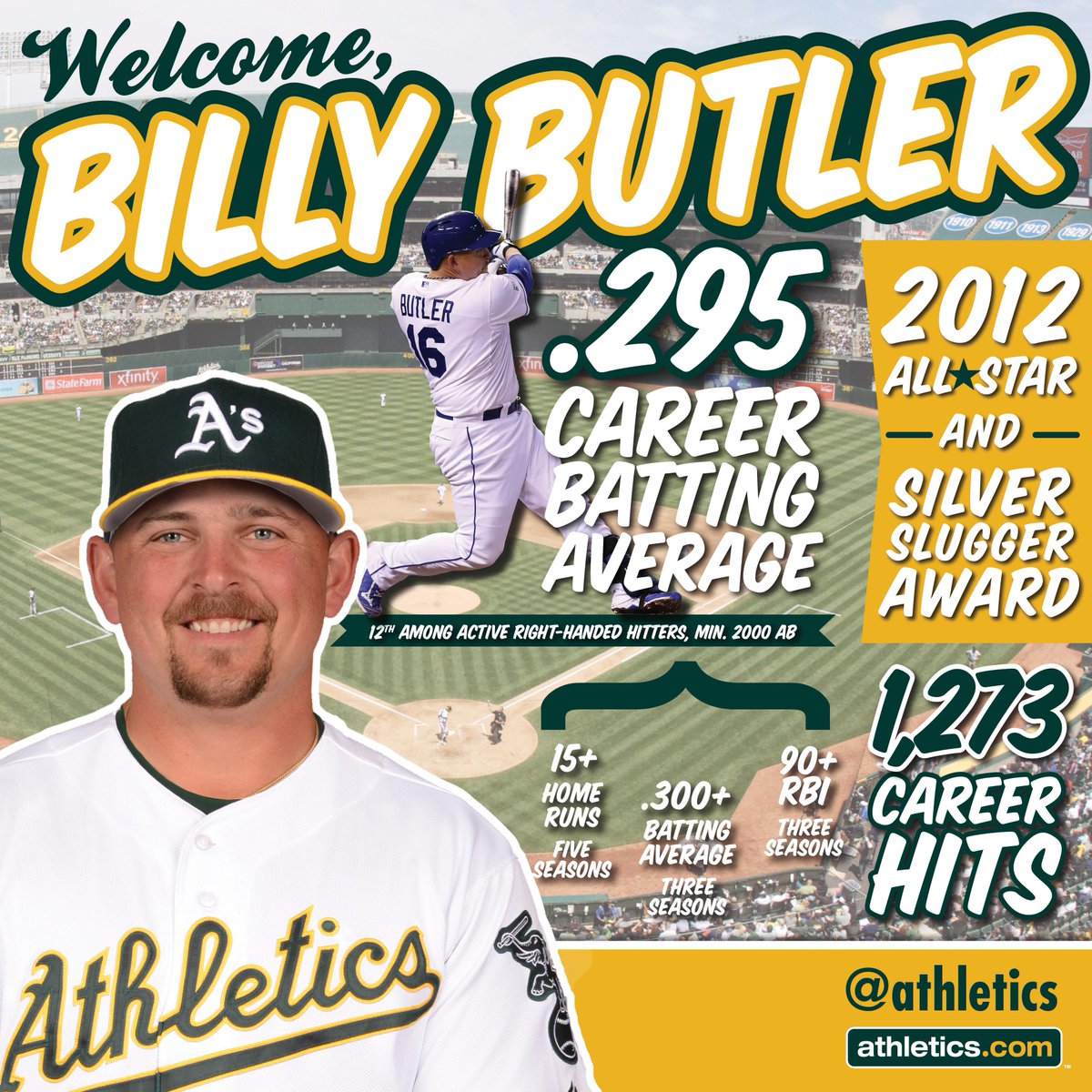
"Hey, we may not have Josh Donaldson, but look - Billy Butler!"


   The Blue Jays have one of the largest pro and amateur scouting staffs in baseball, and a wealth of senior administrative experience.  If they deemed Barreto surplus, it may have been because of a flaw not yet apparent in his game, or because they felt there was an adequate depth of projectable players in the system to replace him (hello, Richard Urena).  Or maybe they just felt that this was the price that had to be paid to land a premium player.  Even though GM Alex Anthopolous said Brett Lawrie was the key to the deal being consummated, maybe the A's don't even entertain the notion of a trade to begin with unless Barreto was included.
 No matter what, if we want to watch him play in Lansing, it may have to wait until August, when Oakland's Midwest League affiliate, the Beloit Snappers, are in town to play the Lugnuts. We're betting he will already be in the High A California League by then.

Monday, November 24, 2014

Clutchlings Blue Jays Prospects: The Top 10


      We've given a great deal of thought to this year's top prospects list.
  We do like to take our time putting it together, assembling a fair amount of research from a number of credible sources, and our own observations of prospects we have seen in action. We also like for Fall Instructs, the Arizona Fall League, and the first wave of GM meetings to play themselves out before putting a list together.
  This year, unlike any other in recent memory, has been one of the more successful ones in Blue Jays minor league history.  The club's focus on drafting high risk, high reward players starting in 2010, along with a concentration on the international market and drafting players who may have been overlooked because of injury and/or college commitments, is starting to bear fruit.  For the first time, we won't be grasping for names when we compile our list of the 11th to 20th ranked prospects - we actually had a tough time not including some names, and found ourselves making up top 10 and top 20 lists, only to remake them a week later.
   For the first time in several years, the farm system actually graduated players to the major league club who made a more than limited contribution to the team.  Marcus Stroman came up in early May and struggled out of the bullpen.  Sent back to Buffalo to get stretched out as a starter, he came back to the club and quickly became a mainstay in the rotation, posting a record of 3-0, 1.71 ERA with an 0.95 WHIP and .193 Opponents BA in 5 July starts.
   Aaron Sanchez started the year at AA, and was promoted to AAA in June.  Called up to the big club and installed in the bullpen, Sanchez cut down his repertoire of pitches to his fourseamer and sinker and was lights out in relief, posting a tiny 1.09 ERA in 24 appearances.
  On September 1st, when major league rosters expanded, the Blue Jays promoted an incredible 8 minor leaguers.  Even though the club was out of contention, lefthander Daniel Norris and outfielder Dalton Pompey had an impact, and served notice that they were in the running for spots on the 25 man roster when spring training breaks next March.
   A note about qualification for this list before we begin.  A player with more than 90 at bats, or 45 innings pitched, or 45 days on a major league roster before September is no longer to be eligible for rookie of the year voting the following year.  Using that guideline, Marcus Stroman doesn't qualify as a rookie any more, but Aaron Sanchez does, and to us still merits consideration as a prospect.

1.  Daniel Norris
   This was a tough decision, as it came down to Norris or Sanchez.
While Sanchez had a scintillating MLB debut, Norris actually had a far better season as a starting pitcher.
Minor League Baseball's pitcher of the month for May, Norris started the year in High A, and finished it in the majors.  It's been some time since a Blue Jays prospect had as dominant a season.

  Promoted to New Hampshire in June after dominating Florida State League hitters, Norris actually struggled to economize his pitch count, but the Blue Jays brass had seen enough in his last AA start (6.2IP, 5H, 1 R/ER, 0BB, 8K) to challenge him further with a promotion to Buffalo.  And whatever adjustments he had made in that last AA start carried over to Buffalo, where he struck out 32 hitters in 16.2 innings over his first 3 starts.  At that point, having thrown 118 innings for the season (20 more than his career high), it was announced that Norris had made his last start.  With Buffalo in the midst of a playoff race, however, the organization had a change of heart, and let Norris make one last start against the Red Sox Pawtucket affiliate (who the Bisons were chasing for the final playoff spot).  We made the trip to Coca-Cola field to watch the start.  Norris breezed through his first two innings, but suffered a noticeable decline in his fastball velocity, and the Paw Sox hitters knocked him out of the game by the fourth.
  The decline in velocity, of course, was due to bone chips in his pitching elbow, which were removed at season's end.  Norris was part of the massive airlift of prospects who were called up when rosters were expanded on September 1st, and he made his MLB debut four days later.  Called upon to face the Red Sox David Ortiz in a LOOGY situation, Norris got a first pitch strike on a curve, and then five pitches later froze Papi on an inside curve.  The ironic part of this story is that there was a bit of a language barrier problem between Norris and Dionner Navarro.  In a quick chat before he started his warm up pitches, a pumped-up Norris told Navarro that he preferred to go with fastballs because he felt he didn't have the feel for a curve, only to have Navarro put two fingers down for his first pitch.
   Norris was the Blue Jays 2nd round pick in 2011, but signed for the 20th highest bonus, largely thanks to the club's inability to sign first round pick Tyler Beede.  Regarded by some as the best prep lefthander in the draft that year, he became the first high school lefty from his draft class to reach the majors.
   Norris' first year and a half in pro ball was a bit of a disaster, as the club had altered his delivery, and he showed a reluctance to rely on his fastball.  After getting pounded in an early May start at Lansing last year, Norris and pitching coach Vince Horsman had a heart-to-heart, and Norris began to use his fastball more, which only improved the effectiveness of his secondary pitches once his command improved.  Since June of last year, he has struck out 213 batters in 176 IP.
   Norris posted the highest strikeout rate in all of minor league baseball (11.8/9) this year - his K rate actually improved at every minor league step up the ladder this year:

 
Fangraphs

    Norris experienced an uptick in velocity this year, usually sitting between 91 and 95 with his fastball, touching 97.  His slider has plus potential, as does his change up.  Norris throws with an upright delivery, ha smooth mechanics toward the plate that gives him good downhill plane on his pitches, and usually leaves him in a good fielding position after he completes his windup.
   Norris, to some extent, came out of nowhere this year.  He went from being nowhere near anyone's top 100 Milb prospects to leaping into the top 10.  We've had our eye on him since his transformation mid-season last year, but even we didn't think he would make a leap of this significance this season.  He may start the season in Buffalo, but it's only a matter of time before Norris established himself at least in the middle of the Blue Jays rotation.

ETA:  2015 Mid Season
Projection: #2/#3 starter
Worst Case Scenario:  8th inning bullpen guy

2.  Aaron Sanchez
   There were some who thought the Blue Jays had made a huge mistake when they took Sanchez with the 34th pick of the 2010 draft.  A tall, lanky, and gangly specimen, there were some who thought that Sanchez would always be overvalued because of his size.  The Blue Jays brought Sanchez along slowly, putting him through two seasons of rookie and short season ball before his first full season with Lansing.  Command issues plagued him almost from the outset. Last year at Dunedin, the whispers about Sanchez having command issues and not being quite the sum of all his parts began to grow.  By the time the Arizona Fall League rolled around, the Sanchez bandwagon had become noticeably lighter.  Here's a comment we had from a reader a little over a year ago:

   Funny how tendencies have a habit of sticking around. I saw Sanchez pitch as a high school prospect in the 2009 Tournament of Stars in Cary, NC. While he had that easy delivery and good velo that earned him more than his share of excitement from the scouting community, I came away with a 'what the hell am I missing here' impression. His lack of command and inability to repeat pitches stood out like a sore thumb. His results weren't bad, given the unrefined tendencies of high school batters to swing at high-velo or high-movement pitches that aren't strikes. But still, I thought he was a project, and it raised my eyebrows when he went in the first round with an almost-$800K bonus. You never know when a player can blow up, but following my own son's progress to pro ball made it glaringly obvious that for a group of professionals whose sole job it is to evaluate talent, scouts just get it wrong with their projectability assessments way more often than they get it right (in both directions!). To me at the time, Sanchez should have been more like a 3rd-to-5th round sign. His lingering tendencies have produced results that have proven that so far. I do hope for his sake that he has a serendipitous encounter with some pitching coach who is able to spot that as-yet unknown little fault in his delivery and turn his fortunes around
 This did not deter the Blue Jays, nor Sanchez.  Some of his struggles may have been to the organization tinkering with his delivery, having him land in a more upright position, and due to his experimenting with a sinker.
   Fast forward to 2014.  Sanchez opened the season at AA, and even though the results were somewhat mixed (40BB in 66IP), the club challenged him, in what would become a system-wide trend,  with a promotion to Buffalo.  Sanchez demonstrated better control after a half dozen AAA starts, when they put him on the next path of his development, sending him to the bullpen.  Two relief outings later, Sanchez found himself in an MLB bullpen, tossing a pair of scoreless relief innings against the Red Sox.
   Sanchez was barely hittable for the rest of the season, filling a huge set-up role void in the Toronto bullpen, and posting a miniscule 1.09 ERA in 33 innings, with a ridiculous 0.70 WHIP.  The main reason for Sanchez's success was the club paring down his repertoire of pitches:

Brooks Baseball

   Not having to worry about getting hitters out a second time through the order, Sanchez could use his fastball, which seems to explode on batters from his easy-effort delivery to induce swings and misses, or weak, groundball contact.  He consistently sat between 93 and 95 with his fastball, and touched 97 with it.  Sanchez gets plenty of extension from his delivery,   His curve has been described as major league ready since he was in A ball, and his change improved this season.
   The Blue Jays appear to have a tough decision on their hands with Sanchez:  keep him in the bullpen, where he's been successful, or let him vie for a spot in the starting rotation, where he has not met with as much success.  For the time being, the club appears to be willing to let him compete for a starting job in spring training.  

ETA:  2015
Projection: #2/#3 starter
Worst Case Scenario:  late innings bullpen guy

3.  Dalton Pompey
  The Blue Jays took a flyer on Pompey in the 16th round of the 2010 draft.  The Mississauga HS product was described as toolsy, but incredibly raw.
   His development over the course of his first three pro seasons was very slow and unremarkable.  A hand injury limited his playing time in 2012, and his first year of full season ball at Lansing was fairly nondescript, until he caught fire in the final weeks of the season, 
   He carried that hot finish over to the 2014 season, hitting .319/.397/.491 with 29 stolen bases in a little over two months of play in the Florida State League.  Promoted to AA, where pitchers have a plan, and don't rely just on their ability to blow the ball by hitters, Pompey needed a week to figure things out, and began raking once more, earning a trip to the Futures Game.  His storybook season didn't end there, however, as he joined Buffalo in August and was a sparkplug at the top of their batting order during the Bisons' playoff push.  Pompey's season culminated in a call up to the Blue Jays on September 1st, and his 4-4 game with a pair of triples late in the season against Baltimore capped off his rise through four levels of play.  Likely a little worn out from his longest season, Pompey's numbers were a little less than expected against the elite caliber of competition in the Arizona Fall League, but he was named one of the loop's Top 10 Prospects after play ended last week.
   Pompey's breakout year was well worth the wait.  An Milb Gold Glove winner, Pompey has gap-closing speed in the outfield that profiles as a centrefielder, and a plus arm that could play right.  The switch-hitter likes to lay down drag bunts, especially on the left side, and is incredibly quick out of the box.  He has shown both power and patience, drawing walks at an above average rate.  He is also a smart baserunner who uses his speed effectively and wisely on the bases.
   He may start the season in Buffalo, but Pompey has the makings of a first division major leaguer.  He outperformed projections for him last year, and because he is still developing, he may outperform them again this year, even though that would be a tough act to follow.

ETA:  Mid 2015
Projection:  Lead Off Sparkplug Centrefielder
Worst Case Scenario:  Platoon corner outfielder

4.  Franklin Barreto
  Barreto was part of an impressive haul of international shortstops the Blue Jays signed in 2012 (along with Dawel Lugo, who played at Lansing this year, and Richard Urena).  A fabled youth player, all Barreto has done since his pro debut is hit.  Brought stateside for rookie ball last year, Barreto was dominant in the Northwest League this year, at the tender age of 18, in a league filled mostly with college grads.
  Hitting third in Vancouver's batting order, Barreto led the NWL in Games, Runs, Hits, Doubles, RBIs, and Total Bases, and was the league's MVP.  He was also named Baseball America's Short Season Player of the Year.
   Barreto barrels up balls to all fields:

MLBfarm.com

   At 5'9", Barreto has a strong, compact build.  He has plus speed, and profiles as a middle of the order, impact bat.  Like many young players, he still can chase breaking balls out of the strike zone, but there is every indication that a player of his athletic intelligence will ultimately figure that part of the game out.
   The only concerns about Barreto involve his defence.  He committed 26 errors at short for Vancouver, many of them on the back end of double play balls.  His footwork can be awkward, and he doesn't always show great arm strength on long throws from the hole.  Still, he has the type of fast-twitch skills that the Blue Jays covet, and while he may end up at second base or centrefield, the Blue Jays are content to let him stay at the position at Lansing next season, basically until he plays himself out of it.
  Wherever he winds up on the diamond, Barreto's bat will play.  The  It will be no surprise to us if he tops this list next season.  

ETA:  late 2017
Projection:  Middle of the lineup hitter, up the middle defender
Worst Case Scenario:  decent bat, corner outfielder

5.  Roberto Osuna
   The Blue Jays signed  Osuna out of Mexico for $1.5 million in 2011. Already something of a prodigy, the 15 year old Osuna was throwing in the 90s, and pitching in the Mexican League at the time.  He made his stateside debut in 2012, and is still talked about with reverence by Vancouverites for a start he made as a 17 year old in 2012 where he struck out 13 of the 19 hitters he faced.
   Osuna made his full season debut with Lansing last year, and was continuing his steady climb up the prospect charts until he was sidelined with a torn UCL in May, which required Tommy John to repair in July.
   He didn't make his return to competition until July of this year, and pitched for Dunedin in August.  The results, as one would expect, were less than stellar, as Osuna was struggling to regain his velocity and control (although he did have a 12.3K/9 rate in 30 IP).  
  Sent to Arizona to both get some extra work and face some tough competition, Osuna still has yet to post the numbers that he did prior to his surgery.  At 19, there's not a lot to worry about, however.  He did have his velocity back up to between 91 and 93, and touched 95.
  What keeps Osuna near the top of our list is what has been called his advanced feel for pitching.  His innings have been carefully monitored this year, but the bubble wrap will start to come off next year, when he likely will be pitching at New Hampshire.
   Osuna's top secondary pitch is a changeup, which is rated plus.  He caught too much of the strike zone at times in Arizona, and paid for it against hitters who can easily jump on such mistakes.  His fastball can lack movement at times, and the organization is working on altering his delivery to correct it.
   Prior to his surgery, Osuna's body was characterized as high maintenance.  Meaning, to put it blunty, he was chubby.  Both our observations of him in Arizona and reports we have read indicate that he has slimmed down, and appears to be paying more attention to his diet and conditioning.

ETA:  mid 2016
Projection:  #3/#4 starter
Worst Case Scenario:  Set up bullpen guy

6. Jeff Hoffman
   Hoffman has forced us to re-write our list numerous times.
The Blue Jays apparently have had their eye on Hoffman for some time.  Seen as talented but very undeveloped coming out of high school in upstate New York, Hoffman pitched for three years at East Carolina.
  Pitching out of the bullpen as a freshman, he hit 95 with his fastball.  He made what would be his last collegiate start on April 17th of last year, striking out 16.  A game in which he threw 117 pitches.  He felt some discomfort in his elbow late in the start, but told his pitching coach he was ok to continue.  The discomfort, of course didn't go away, and Hoffman underwent Tommy John in early May.
   The Blue Jays had followed Hoffman's every start this year, and were not put off by the surgery, and made Hoffman, who had been projected by many to be a top five, maybe even top three pick, the ninth pick overall, and signed him for a bonus of just over $3 million.
   Hoffman has been described as a premium athlete.  At 6'4", 190, he has the ideal body size and composition for the club - long, lean, and projectable.  His fastball sits 91-95 (his final inning this spring had him at 94-95), and touches 97, with arm side run  and heavy sinking action that generates plenty of weak contact.  He gets great extension with his delivery, and like Sanchez, the ball seems to explode out of his hand.  His curve is projected as plus, and his change and slider developed noticeably last year.  With his athleticism, Hoffman is a premium defender.
   Tommy John, of course, throws this all into question, even though it's becoming almost a rite of passage for young pitchers, and like any surgery that is repeated, the procedure is becoming increasingly successful.
All indications are that his recovery has gone well, and if it continues to do so, he should see game action sometime in May.  His pitch count will be strictly monitored, of course, which will also limit his progress this year.  Most pitchers (Osuna included) get most of their velocity back quickly after returning to competition, but command (see Kyle Drabek) can take longer to come back.
   Hoffman is projected as a front of the rotation starter, and if not for the surgery might have found himself in the major league rotation next year.  All indications are that the Blue Jays got a top three pick for a (comparatively) bargain price.  His progress now will be delayed.  We had difficulty including Hoffman on our original list as a result, but our research indicates his ceiling is so high that we couldn't relegate him to the second tier list.  The Blue Jays have once again rolled the dice.

ETA: mid 2016
Projection: front of the rotation starter
Worst Case Scenario: back of the rotation starter

7.  Richard Urena
 The 6"1" 170 Urena was part of that trio of talented international package of shortstops the Blue Jays signed in 2011, and he is the most likely to stick at the position.
   His defence has been labelled major league ready, although the 19 errors (many of the mental variety) he committed at Bluefield have us wondering if that's the case.
  Urena has those quick-twitch movements that create good reaction to batted balls, and has soft hands, a quick release, and a plus arm.   
   Urena is a natural lefthanded hitter, but took up switch-hitting this year, and reports are that he was successful at it.  He has above average bat speed, and is learning to barrel up the ball.  His power projects as below average, but he does profile as a gap hitter, with plenty of potential for doubles.
  At 18 (he's a day younger than Barreto), Urena spent most of last year in the Appy League, and was called up to Vancouver late in the season to help the C's playoff drive.  Interestingly, he did not supplant Barreto at short, playing second and third in his short NWL stint.  He's ready for a full season assignment, however, and the organization will have a huge decision on its hands this spring as the drama plays out on the back fields of Dunedin.  Will Urena play short at Lansing, with Barreto moving over to second?  The club appears determined to let the latter play himself out of the position, but the time may be right for the move.  Maybe the Blue Jays have their own Trammell-Whitaker combo in the making.

ETA:  late 2017/early 2018
Projection:  #2 hitter, everyday shortstop
Worst Case Scenario:  utility player

8.  Miguel Castro
   If you've read any posts on this blog (including this one), it's obvious that the Blue Jays have an overwhelming preference for a certain type of pitcher when they scout the high school, college, and international ranks. They like them tall (in order to create a downhill plane on their pitches, which can be harder for a hitter to track), lean (that is, not of a high-maintenance body type), and athletic (in order to be able to repeat their deliveries, especially if they have to have their mechanics altered).
   Sometimes the Blue Jays scouting staff colour outside the lines and draft a Marcus Stroman (who is all of the above, except for tall), but otherwise they have stayed rigidly with that guideline.
   And Miguel Castro fits that guideline to a tee 
Castro was a bargain ($180K) signing in 2011.  After dominating the Dominican Summer League in 2012, his stateside debut last year was delayed due to visa problems, limiting him to 30 innings.   He has more than made up for lost time this year, pitching at three levels, and finishing the year with Dunedin.
   Castro's fastball sits in the mid 90s, and touches 99.  His three quarters delivery gives his fastball plenty of arm side run, and a sinking action that generates plenty of groundball contact - essential for a player who may one day pitch in the Rogers Centre.  
   Secondary pitches are the issue for Castro.  His change is his best offering of that group at the moment, with his slider being more of a slurve.  When you throw as hard as he does, however, it makes the secondary pitches less important for now, although he will need more of an arsenal to throw at hitters as he makes his way up the ladder.
  We watched Castro's August 20th start for Lansing on milb.tv, when he threw a 7 inning, 3 hit, shutout gem, his longest stint as a pro.  He was never in trouble until his final inning, but worked his way out of a jam to cap off an impressive performance that proved to be his last at that level.
   BA has projected Castro to be a reliever at the major league level.  Developing a breaking pitch will likely be a priority for him this year.

ETA: late 2016
Projection: mid rotation starter
Worst Case Scenario:  late inning bullpen arm

9.  Kendall Graveman
   A year ago, Graveman, who the Jays took in the eighth round of 2013, was nowhere near anyone's top prospect list.  Lost somewhat in the shadow of Pompey and Norris, he had a season that was simply lights out.
   Graveman started the year at Lansing, and ended it in Toronto, pitching at five levels.  Drafted as a sinker control artist, Graveman added velocity this year as a result of the famed weighted ball program he used during the off-season.
   Promoted to Dunedin in May, Graveman began to experiment with a new grip on his fastball, which resulted in a four seamer that he could cut against right and left handed hitters.  The result was plenty of groundball contact:


   Graveman was promoted to New Hampshire in late July, and was elevated to Buffalo after only one start, and made a half dozen excellent starts as part of the Bisons' torrid stretch run.  On the year, Graveman was 14-6 with a 1.83 ERA, 1.02 WHIP in 27 starts.  Graveman repeats his delivery, and fields his position well.  He, too, caused a number of re-writes of this list.  Graveman may not have the ceiling of Daniel Norris, but he may the most major league-ready player on this list outside of Aaron Sanchez.  Graveman profiles as a back of the rotation innings eater whose path to the bigs may be blocked at the moment, but he would be in the running for a spot on the 25 man roster next spring if the Blue Jays make rumoured deals involving Mark Buerhle and/or JA Happ.

ETA:  2015
Projection:  Back of the rotation starter
Worst Case Scenario:  front of the bullpen guy
10.  Anthony Alford
   
  During the JP Ricciardi era, the Blue Jays deservedly gained a reputation as a club that was primarily interested in using their early picks to draft close to MLB-ready and signable college players.  The club viewed high school players as risky, and with college as an option, their bonus demands would not fit inside ownerships' tight salary demands.
   During the years JP was at the helm, the Blue Jays draftees amassed all of 89.8  WAR (over a third of it by Shaun Marcum and Aaron Hill), putting them in the lowest tier of all MLB clubs.  There are no guarantees in the draft, especially when selecting HS school players who may be years away, but here is a sample of prep players the Blue Jays passed on in the first round over the years.

2001   David Wright
2002   Matt Cain/Scott Kazmir/Cole Hamels
2004   Gio Gonzalez
2005   Andrew McCutchen
2007   Rick Porcello
2009   Mike Trout (in fairness, 24 other teams passed on him, too)

 The only HS grad the Blue Jays took during Ricciardi's reign was Kevin Ahrens in 2007, who has played only 73 games above High A in 8 minor league seasons, and is no longer with the organization.
   The result of this policy was a depth of prospects that doomed the franchise to second division status for most of the decade.
   In 2010, that draft strategy changed, under the new stewardship of scouting director Andrew Tinnish and GM Alex Anthopolous.  The club followed the new way of thinking that believed that college grads sometimes came to the pros with bad fundamentals, and/or as damaged goods, especially pitchers.  Tinnish and Anthopolous went further, looking specifically for high risk/high reward athletes that might take longer to develop, and the scouting community had shied away from.  They looked in places few scouts had bothered to spend much time in before, including Mississippi.
   Mississippi is hardly a hot bed of high school baseball.  Teams prefer to see how top prep players from the state fare against collegiate competition before making a commitment - Hunter Renfroe was a first round pick last year, but was taken in the 19th round as a HS senior.
   There are several reasons why the state is something of a scouting backwater.  First of all, football is king in the state.  Kids in Mississippi dream of growing up to play in the SEC, and many take the junior college route to get there.  Even if they show some promise on the diamond, most top two-sport players are under immense pressure to choose football.  Petal is a town of just over 10 000 in southern Mississippi, near Hattiesburg.  Take a look at Petal High's football stadium:


   Granted, the Americans place a higher priority on building athletic facilities than we do here in the land of free medical care for all, but Petal's stadium complex is bigger than many Canadian universities'.    
   The poverty rate in the state is the nation's highest, according to the last census.  Travel ball, select teams, and showcase events are out of the reach financially for all but a few kids.  Mississippi also has a highly rural population, with less competition between schools.  Most major cities in the country have more 5A schools than the entire state has.  In an article about high school prospects in the state by BA's John Manuel, one scout compared the obstacles Mississippi prospects face with the transition from a slow pace, rural lifestyle to the bus rides and grinder mentality with what young players from the Dominican are presented with.  
    The Blue Jays bucked the traditional views of scouting in the state in the spring of 2012, and came away with a pair of high schoolers who came with the toolsy-but-raw tag.  DJ Davis was touted as a potential five-tool player, and the Blue Jays took him with the 17th pick of the first round.  Named a top 20 league prospect in his first two short seasons, Davis struggled mightily at the plate in his first go at full season ball this year, striking out in nearly a third of his plate appearances.
   With their third round pick that year, the Blue Jays chose Petal outfielder Anthony Alford, who was a two-time Gatorade state football player of the year.  As late as April that year, Alford was telling MLB teams not to bother drafting him, as he was intent on playing football and baseball at Southern Mississippi.
   And, again, if you have read other posts on this blog, you know how that worked out. He was described by many as a third round pick with first round talent.
   We won't recount the long and winding road that led Alford, after the Blue Jays had tried to extend his contract and convince him to give up football this summer, to suddenly quit the Ole Miss program and accept the Jays offer in late September (but we encourage you to look it up on our blog if you don't know the story).
   The long and short of it is that Alford, at the tender age of 20, has been through a great deal, and now finds himself and his young bride on the other side of the world, taking a crash course in pitch recognition in the Australian Baseball League.  
  Alford has caused us to rewrite this list more than any other prospect on it.  He is the best athlete in the system, as well as possibly the fastest, and in our viewing of him on ABL tv, has shown great instincts on the basepaths and in the outfield.  At the same time, he's shown how far away he truly is.  In his first few weeks of ABL play, he has shown developing patience, but has chased a lot of off speed pitches out of the zone.  In his early at bats, he appeared to be going up to the plate and hacking, but at least he's now seeing more pitches, and appears to have a plan.  Many of the pitchers in the ABL are the crafty veteran types many years his senior, and it's likely he hasn't seen breaking balls of this quality yet in his career.  Alford has a short, quick swing, and in his brief pro career has barreled up the ball to all fields.  His speed on the bases is a legitimate distraction for the opposition.  
   Alford will need time to mature.  Dreams of seeing him patrolling the Rogers Centre carpet next year have changed now to seeing him there in 2016 or even 2017.  He has played so little (less than 100 ABs in three seasons) that we have to give him time to make up for that lost development.  He just has so much talent that we couldn't leave him off of this list.

ETA:  2017
Projection:  lead off hitter, centrefielder, base stealing king
Worst Case Scenario:  fourth outfielder